Search This Blog

Showing posts with label activism. Show all posts

Saturday, January 13, 2024

This Book is Banned -- a basics on censorship for children


Banned Books Week is held every September, yet in these past few years, it has become even more important to educate the public about. Celebrating the freedom to read is a cornerstone of a free community. When others dictate what is or isn’t available to read based on biased opinions, it is dangerous. I teach my older elementary school students about the history of banning books and they are continually shocked by how it starts small, but then grows to epic proportions. Student lessons on this even reach our present-day times when book bans and challenges are at the highest levels on record. 


As an educator and librarian I am trained on how to select the best books for my school’s library collection. A book that I will definitely be adding and reading with students is the humorous, yet informative picture book, This Book is Banned.  


From the start of the story the narrator is speaking directly to the reader, warning them that they will never make it to the end of the book because an arbitrary decision to ban the book’s topics will keep them from reaching its conclusion. Through humor, the writer demonstrates how book bans affect people’s ability to choose for themselves.


The hand-drawn illustrations by the artist, Julia Patton, are detailed and they help the information get through to the reader in a funny way. Readers will want to go back and look at the images again and discuss what they see. 


I highly recommend this book for elementary students and the larger community. It sends an important message while entertaining the reader about this topic. Very rarely do picture books do this well. It would benefit the reader to supplement this book with further research into the current situation in which books are being banned, especially books by people whose perspectives are not widely shared. 


Thanks to NetGalley for sharing an ARC of this book with me.


Here is an interview of the author, Raj Haldar, as he discusses what brought him to write about this topic and a video of him reading aloud the book:


Listen to and/or read  NPR's All Things Considered news broadcast about This Book is Banned.

Middle grade readers can continue their study of this topic by reading the following chapter books:

 Ban This Book, by Alan Gratz 


Attack of the Black Rectangles, by A.S. King


What are more books that deal with censorship that you'd like to share in the comments?


Sunday, January 23, 2022

Revolution in Our Time: the Black Panthers' rise, fall & legacy today


Kekla Magoon's young adult, nonfiction book, Revolution in Our Time, about the history of the Black Panthers, their enduring struggle for progress in their lifetimes and the recurring themes in the modern-day American society is a poignant informational book that benefits everyone who reads it.  

The Black Panther Party played a large role in pushing back against racist policies in communities, however, the media portrayal focused on the sensational aspects rather than the multi-faceted parts of the movement that actually helped communities.  This is where Magoon's book comes in to set the record straight on how women and children were the focus in order to provide for their basic needs while in poverty.  

The book starts out when in 1967 a group of Black Panthers walked onto the floor of the California State Legislature to express their position on Black people being able to defend themselves against unlawful attacks.  How did this group form and come to this pivotable moment when they were splashed in headlines all around the country?  Magoon then takes the reader back to 1619 until 1965 and summarizes how Black people have endured inhumane treatment up until 1965.  She explains the group's formation in 1966 during the Civil Rights Movement and how they grew in numbers all while being targeted by law enforcement and the FBI.  Magoon finishes the book by going full circle to when the group disbanded in 1982 until the present day struggles for the same protection under the law that was the cornerstone of their platform from their formation. 

It reminded me a lot of Stamped: Racism, Antiracism and You and You Call This Democracy?, both written with a young adult audience in mind.  Our youth deserve to know the historical events that have led our country to the state it is in and how they can help improve their world by not repeating mistakes of the past and recognizing what has worked before.  This is an excellent book for teens and adults to read together and use it study the figures and events on their own.  Full of photographs, quotes, and a storytelling technique that will leave a lasting impression in the mind and heart of the reader, this should be shared and discussed by all who care about Black people.


Click HERE for my book review of this book.

HERE is a short video of Kekla Magoon discussing her book.

If you have middle grade readers (ages 8 - 14) who'd like to learn more about The Black Panthers I'd recommend Rita Garcia-Williams' award winning trilogy:


Friday, August 6, 2021

The Revolution of Evelyn Serrano: a Puerto Rican voices & activism tale


The Revolution of Evelyn Serrano by Sonia Manzano is a middle grades, historical fiction novel set in Harlem, New York in 1969.  It's a Pura Belpre Award Honor Book and it was awarded to Manzano, "a Latina author whose work best portrays the Latino cultural experience in a work of literature for children or youth."  I learned a great deal about Puerto Rican history and how their experiences on the island shaped their community in Harlem. A story of truth, pride and forgiveness that will stay with readers long after they finish the last page.

Evelyn, a teenager who lives with her Mami and step-dad in El Barrio in east Harlem is figuring out who she wants to be.  Maybe going by her middle name instead of Rosa will help her stand out.  When her estranged abeula comes to stay with them Evelyn's shocked by her appearance, demeanor and attitude--she's so different than her mami!  Evelyn learns secrets about her family in Puerto Rico and starts to get involved in the Young Lords' activism to be treated better in their community.  Evelyn says, "...I did get this: that it wasn't just us Puerto Ricans who lived in a culture that didn't like us and that other people in the world lived in the same situation."


I loved the character of Maria on Sesame Street so when I learned that the actress who plays her, Sonia Manzano, wrote this novel, I knew I had to read it.  What stood out to me was Puerto Rico's history, like the nationalists who wanted the island to be apart from the U.S., how during the Great Depression it was even worse for people on the island, and how people in the U.S. who were born here but are Puerto Rican are called, "Nuyorican." Adults will enjoy the book with famous cameos by other well-known Americans and the musical references to Pepe y Flora may get their music playing while reading this story:


Manzano includes resources more details about this time in history in her Author's Note and explains that the Spanish words and Spanglish that are used in the book are regional phrases and what her family used to say.  For readers who want to learn more about this time in history, a list of resources for further reading is provided.  There is also an Educator's Guide for teaching this book with students and it gives more background on Manzano and what brought her to write this novel.  


Sunday, June 13, 2021

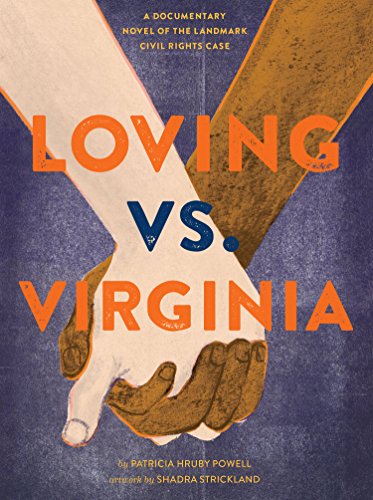
Making Interracial Marriage Legal: Loving Vs. Virginia


According to Britannica.com, Loving v. Virginia, legal case, decided on June 12, 1967, in which the U.S. Supreme Court unanimously (9–0) struck down state antimiscegenation statutes in Virginia as unconstitutional under the equal protection and due process clauses of the Fourteenth Amendment.


A middle grades, historical fiction, novel-in-verse, Loving Vs. Virginia by Patricia Hruby Powell and illustrated by Shadra Strickland,  tells the story of a civil rights topic that has everlasting effects on the U.S.  

In the 1950s a majority of the country had laws against people of different races marrying.  Through this story the reader learns of Mildred (Millie), a young Black woman who lives in Virginia with her large family out in the country.  They farm, run a business and love playing music and dancing with their friends.  Richard, a young white man, is one of those friends who grew up with Millie.  As they get older they fall in love and have two babies.  They go to Washington D.C. to get married but are arrested after they return to Virginia.


Told in alternating viewpoints, the story unfolds as Rich and Millie Loving become outspoken about their right to marry and live in Virginia with their family.  Their tale is interspersed with primary sources that take place alongside their landmark Supreme Court case.  Moving, tender, and honest, every teen should read this book to understand more about the history of race relations and civil rights in this country. 

Watch a video interview of the creators of this book HERE.

Uprising & Boys Without Names: child labor, then & now


Uprising, a middle grades historical fiction novel by Margaret Peterson Haddix, explains the role of worker's rights, suffrage, immigrants' living conditions, and activism in the early 1900s that led to the tragic Triangle Shirtwaist Factory fire in New York in 1911.  The novel alternates between three different girls' point of views and each one seems to be in their own world until their lives intersect.  The reader also knows that the tragedy of the fire will happen at some point so reading the story is extra suspenseful because there are constant dangers leading up to the fire.  Readers get to know the three girls incredibly well so by the end of the story the way they either survive or not is especially hard-hitting to the reader.


I used this novel as a whole class read with my American History classes for 7th and 8th graders and it sparked many discussions about living and working conditions for immigrants in the late 1890s and early 1900s. Haddix brings in facts about the time period and real people so students can get a sense of what actually happened.  They went on to read about and research the events and people that Haddix names in the novel.  New terms, such as "scab" and other vocabulary that we use today is shown in the book so it helps students understand those ideas in an enriched context.


After reading this novel and mind-mapping while reading it, our students got the chance to have a Skype author-visit with Haddix.  She was incredibly gracious to share with us her research process for this topic and answered all of the students' questions.  I highly recommend using this book in American History classes and engaging with Haddix before, during or after reading the novel.   

This was also a smart book to choose because we studied other labor movements, like Cesar Chavez and Dolores Huerta  , and students could better connect with those parts of American History.  Child Labor is a subject in which my students took an interest in and they explored that topic by reading the book, The Boys Without Names by Kashmira Sheth:


Sheth describes the conditions that bring together a group of boys forced to work against their will in Mumbai, India.  After reading and discussing the book, our students engaged in a discussion with Sheth through a Skype virtual-author visit.  Our students continued to learn about the plight of child labor in various places in the world, as well as in the U.S.


Both of these books offer middle grade and high school students the chance to learn more about important topics with memorable characters and settings. If you want a good one for middle schoolers, try Threads by Ami Polonsky about a young girl in China forced to work in a purse factory who reaches out for help. 


Saturday, January 30, 2021

We are Water Protectors: universal stewardship


 We are Water Protectors, written by Carole Lindstrom and illustrated by Michaela Goade, reminds the reader of universal truths:

1. nature is important

2. we are all connected

3. it is up to us to protect nature


Told through rich, rhythmic text and luminous nature illustrations that move across the page, the young Indigenous girl's story is a simple, yet complicated story that offers much discussion for any age of reader.  For the young readers, they can identify that the black snake will be dangerous to the girl's community, therefore, she must drive out the snake at all costs.  For the older readers, they can make the connection between the black snake and corporations that harm the environment and to current events where Indigenous people united to block the drilling on their land.


The Indigenous girl empowers herself to be a steward for the Earth's water and animals who cannot stand up to those who bring them harm.  This is a relatable theme for children and adults to discuss.  There is a pledge at the end of the book that asks the reader to join the duty of being an Earth and water steward.  The author's and illustrator's notes at the end of the book also provide more context for the story. Since it is an #OwnVoices book, the visuals and language is authentically used.  The reader can learn more words in the Glossary and additional sources for information are offered for further study.  


Goade won the Caldecott Medal for her work on this book in the Youth Media Awards in 2021, and is the first Native American person to win the award.  Read Across America has more discussion questions and ideas for writing prompts that accompany this book.


Thursday, January 28, 2021

Dress Coded: a middle school Me Too tale


Dress Coded, a middle school-based novel by Carrie Firestone, ticks all of the right coming of age boxes for adolescents: friendship issues, family problems, romantic uncertainties, raging against unfair rules at school.  Only this story is told through a series of podcast episodes, lists, letters, and prose from one character's perspective, Molly. 

 Molly is about to graduate from middle school and the biased treatment that she witnesses her friends receive daily at the hands of the school administration based on what they wear to school causes her to take action.  She starts a podcast where students, both past and current, who have been affected by the school's dress code policy share their stories.  They find strength in one another and use that bond to strive to change the rules.  

Although Molly hasn't been called out for her wardrobe, she can empathize with her friends' ongoing treatment because her own older brother has been belittling her for years.  Will Molly learn to face her own family issues while attempting to help the next wave of students entering middle school?

This is an important book for young people to read, as well as educators.  As a teacher myself, I forget sometimes how it feels to be a young person.  Building relationships with students as individuals is more important than teaching content because if the students don't know that you care about them and their lives, they won't bother learning from you.  

Dress Coded is a great pick for a book club due to the various topics Firestone weaves into the story:  vaping, drifting friendships, identity, gender issues, self-esteem and using your voice all are factors that drive the story forward.  With social media being increasingly accessible, too, this opens up a lot of conversations about what consequences come with having that readily available audience.  It is a tool that can help or harm so the choices that Molly and her friends make throughout the course of the book can be debated.  That is the beauty of stories, they get better when you hear other people's interpretation of them!


Ghost in the Night: a spooky story for preteens

  Ghost in the Night by award-winning author, Tiffany D. Jackson, is a middle grade chapter book that is perfect for readers who want an in...