Search This Blog

Showing posts with label artist. Show all posts

Monday, April 17, 2023

Understanding the misunderstood worm


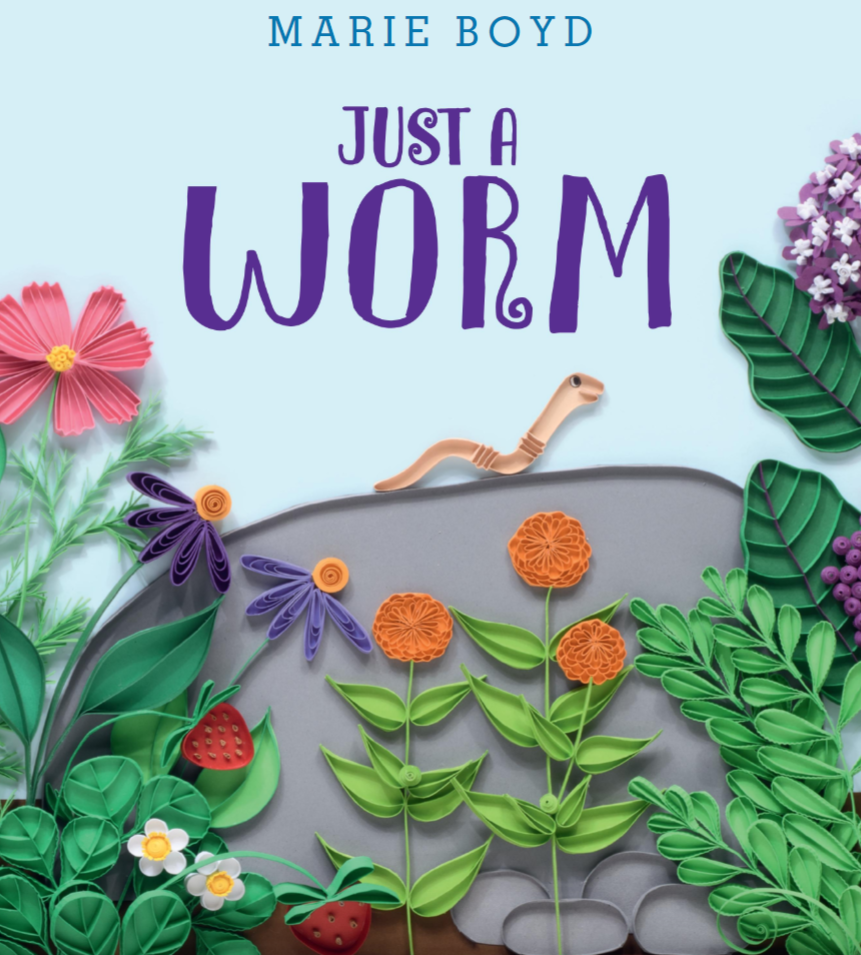
Spring is in full force and as people tend to their gardens, one animal that inevitably pops up is the worm.  Love them or hate them, they are here to help the earth in many ways.  As a teacher, parent and librarian, I seek out picture books to help young people understand the why behind creatures in nature so Marie Boyd's debut story, Just a Worm, does exactly that! Other than the sweet story of a worm, Boyd also has illustrated the book with an artistic paper cut technique called, quilling. You can learn more about her craft on her website where she has a tutorial on how to make a snail! I am excited to share this with my students and daughter. 

I had some questions for Marie Boyd regarding her book, its topic, her inspiration and other topics. Here are her responses: 


1.    Why did you decide to write about a worm of all creatures?


Hi Fallon, Thanks so much for having me on The Story Spectator! I’m excited to be here. I decided to write about a worm because when my son was younger, I often told him “It’s just a worm” when he saw worms on the sidewalk. One day I started thinking about how a worm might respond if it could understand my words. That question led to my debut picture book Just a Worm.


2.    What do you hope readers will gain after reading your book?


In Just a Worm, after being called “just a worm” by two children, Worm embarks on a journey through the garden to prove them wrong. Along the way, Worm encounters several insects and other creatures, each of which has important qualities. But what can Worm do? I wrote Just a Worm for everyone who has ever compared themselves to others and felt that they have fallen short. I hope that Just a Worm will encourage readers to consider the special ways that they contribute to their families and communities.


3.    How did you get into quilling?


I learned about quilling by chance. I was at a craft store buying fabric when I came across some quilling supplies. I didn’t know what quilling was, so I looked it up on my phone. I was intrigued by what I saw and bought the supplies. I started quilling cards for my family and friends and quickly fell in love with quilling. I had a lot of paper that I had collected over the years for various craft projects so eventually I began cutting my own quilling strips. That opened so many new creative possibilities, and eventually led to me using quilled paper to illustrate Just a Worm.


4.    What came first, the words or the illustrations?


The story started with the phrase, “it’s just a worm,” but when I thought about what Worm’s garden would look like I imagined it quilled.


5.    Do you have a special experience or memory with gardens?


I have so many special memories with gardens and the illustrations in Just a Worm draw on some of those memories. As a child, I often helped my parents in the yard and many of the plants in Just a Worm are inspired by plants from their garden.  I love gardens so much that I got married in a garden.


6.  What advice do you have for people who think worms are gross?


Worms play an important role as decomposers and it is possible to appreciate worms and what they do from a distance.


Thanks again for hosting me and allowing me to share a bit about Just a Worm. If your readers are interested in learning more about how I illustrated Just a Worm, I share quilled crafts and more on my website at www.marieboyd.com. Happy reading! 


The book, Just a Worm, is released by Greenwillow, an imprint of HarperCollins, on March 14, 2023, so you can get it now!   A big thanks to author Marie Boyd for taking the time to speak with me about her first picture book.  I hope to see many more of her works in the future. 
 

Thursday, February 17, 2022

Violets are Blue: a middle grade story of family secrets


Violets are Blue by Barbara Dee is a poignant look at how one middle schooler, Wren, tries to deal with her family drama by escaping into her passion for special effects makeup.  This is a book that brings up important issues that young people deal with or may see in their friends' lives.  It offers a chance for readers to discuss issues such as divorce, being the new kid in school, addiction and having half-siblings in a safe way.  Dee realistically writes the characters and situations so the reader roots for them to make better decisions in order to bring relief to their ailing hearts.

Wren experiences a traumatic family event when her father leaves her mother for another woman, moves away to New York City and has twins with her.  Stuck in the middle of her parents, Wren just wants everyone to be happy so she avoids telling them about the other one's lives.  Her escape from this tension is into the CatFX YouTube channel where Cat teaches her viewers how to transform faces with makeup. 

 Wren is pushed out of her comfort zone when her mom decides to move them to a new town where Wren is to start 7th grade.  Her mother's actions keep getting more alarming and when Wren tries to handle it on her own, it becomes so big that it's out of her hands.  Wren reaches a breaking point, will she be able to come out of it unscathed?


I highly recommend this book for middle grade readers and adults who want the perspective of a tween who is doing her best in a tough situation.  Dee is a seasoned writer whose other books also touch on young people who are challenged by life.  Check out more of Dee's books below:


Tuesday, January 11, 2022

Author/illustrator Spotlight: Steve Jenkins


I didn't envision my first blog post of 2022 being in honor of someone who has passed away, but here we are.  The world lost an artist today whose work will go on to resonate with readers forever.  Steve Jenkins has been my go-to nonfiction author and illustrator the entire time that I have been in education.  His picture books spark curiosity, conversation and always lead to students sharing stories about themselves.  In his 80 books he has published, Jenkins focused on scientific topics found in nature and presented those in brightly formed paper collages that look like photographs, they are so well done!

Usually my second grade classes have the chance to study Jenkins' work for several weeks and from then on they can always be found returning to his books, like old friends, again and again.  I first present Jenkins and his wife and work partner, Robin Page, and with students we explore his website that has his book covers on a virtual bookshelf.  


As I scroll through the virtual bookshelf, students help me read the titles, we discuss what they notice about the cover designs and they share if they have seen or read the books before.  Then I show them what books we have in our library collection and they are eager to get their hands on them.  I read aloud from the ones they react to the most. We pass them around and as the students browse they show one another what they find interesting and even try to call dibs on what book they want to check out.  


Finally it's time for students to pick a book that inspires them to create a collage in the style of Jenkins.  We watch a video of Jenkins working and we describe together what he is doing.  As the students notice that he first creates a rough sketch, then using his sketch he makes a larger version with glue and layers of paper.  They cannot wait to dive in and try it themselves!  


For further extension, I've had students use an online encyclopedia or website to add facts to their collage.  Other students add more details in terms of background images and additional scenery to add to the setting.  Some write poems and stories inspired by their collage.  Others simply enjoy looking at what their classmates created and showing them what they made.


I hope that this gives some teachers, librarians, and families ideas for how to use Steve Jenkins' books with their children and students. I know that I will continue to do so, year after year, not because he is an award-winning illustrator, which he is, but because he makes learning memorable for readers of all ages.  


Monday, May 17, 2021

I Wanna Be Where You Are: YA music/dance/art rom-com


I Wanna Be Where You Are is a young adult chapter book by Kristina Forest.  It is a coming-of-age novel that mostly takes place over the course of a week when Chloe schemes with her best friend to sneak out of town to audition for a dance company when her mother forbade her to do that.  When her next-door-neighbor, the annoyingly cute Eli, blackmails her to tag along for the road trip, Chloe is forced to go along with it.  This is when the adventure begins for both of them.  From accidents to romantic tension and snippets about a mysterious history between them, there is a lot to contemplate while enjoying this story.

Chloe's father passed away from a car accident when she was little and she, too, got hit by a car just last year.  Her mother has increased her over-protectiveness of Chloe to the point where Chloe doesn't think she will ever get to leave the house after graduation.  Eli is dealing with his parents' divorce and sister going away to college.  He fell into some self-destructive habits and there is no coming back from deciding to major in art rather than pre-law for college.  Through the story, Chloe and Eli confide with each other on some topics, but not others.  Readers can consider what they would do if they were in Chloe and Eli's shoes.  How would they handle the pressure they are put under by their families.  How are they more alike than they know?

The story goes by quickly and by the end of it the reader has gotten to know these two characters so well that they just want them to be happy.  Are they happier together or having gone through the week supporting each other enough to get them to be honest with their families?  

I enjoyed the banter between the characters, their language, references and musical choices were all authentic.  Readers will also feel comfort in being in Chloe and Eli's world.  Will they commit to their own developing identities or give in to what their parents want for them?  This is an important idea to which teens can relate.

Forest, the author, gave a great interview on the Fierce Reads blog where she gave some background on how she came up with the idea for this book.  Readers will be able to learn more about its origins and read an excerpt from the novel.


Monday, May 3, 2021

See Yourself in a Story: My Favorite Book in the Whole Wide World


How do we improve attitudes towards reading and writing in school?  In my experience as a classroom teacher in grades 4-9 and as a school librarian in grades K-8, I have found that the more social and collaborative it is approached, the more students tend to join in the games, discussion, and yes, even the writing prompts that result.  


I asked students to share why they thought that reading gives you superpowers and what you can do in your life as a reader.  We even talked about if you could go a single day without reading?  Does reading pictures count?  What if you see a stop sign?  Having students point out the importance of everyday literacy is valuable for them to see that beyond school it is to their benefit to learn to read, write, speak and listen.  As a bonus, we took turns showing our superpower poses, like the girl who is flexing in the middle of the poster and we mimicked each other's stances and facial expressions.  


That brought us to  Malcolm Mitchell ,our featured author and his picture book, My Very Favorite Book in the Whole Wide World which is about a boy named Henley who cannot find a good book to read. I asked students if they had to pick one favorite book of theirs, could they do it?  Those who could shared their titles and I shared some of mine, too.  I told them about Malcolm Mitchell's background as a pro-football player whose team won the Super Bowl and how he is currently an author and poet with a children's reading foundation.  We watched his interview on GMA and listened to him read aloud his book:


After listening to the story we discussed how we connected to the book and why it was so hard for so many people to find a good book to read.  The picture book ends with Henley writing a story about himself and turning that into his favorite book.  That took us to talk about how often we use our own lives or people we know in our own writing.  

Finally, the creative writing challenge was introduced with a game that Peter H. Reynolds likes to play when he does author visits.  He will take an illustration and turn it into an imaginary book cover while asking the audience to help him come up with a catchy title.  For our challenge I asked students to come up with creative book titles first.  I rolled 2 storytelling dice and based on the pictures we made up book titles and I wrote them on sticky-notes.  We had enough for everyone in the class to have one sticky-note.


Then we made a circle and as I played music, students passed the sticky notes one direction.  When the music stopped, they looked at the sticky note in their hand, read the title out loud and tried to imagine what the story would be like.  We did this for several rounds and even reversed the direction of our passing.  After the last round, students returned to their seats with their final sticky note.  I could've put the notes into a hat and had students draw them randomly or pass them out or have them projected and they pick the one they wanted, too.


With their imaginary book title in hand, they finish the lesson with designing a book cover for it.  They must include the title, a design or drawing and their name as the author.  If they have time or if they choose, they can brainstorm what happens in the beginning, middle, and end or what the problem/solution is for their story.  They can do this with words or drawings.  As students work I ask the whole class who is incorporating magical elements into their story? Who is making theirs funny? Spooky?  


For those students who don't know where to begin with their book covers, we watch the first few minutes of Peter H. Reynold's Ready Set Draw-ISH! video:


The results of this lesson are that students see themselves as readers, writers, speakers, and listeners.  They see that it doesn't come easy for everyone and despite set-backs there are strategies to use to improve one's skills.  They have a common experience of brainstorming with classmates and connecting with one another by sharing their ideas, writing, and drawings.  


Saturday, May 1, 2021

We are home: A Pho Love Story


 A Pho Love Story is a young adult, romance debut novel by Loan Le, about rival Vietnamese restaurants in L.A. whose owners have a long history of animosity and competition. Imagine the mess that ensues when their high school seniors, Bao and Linh, become partners for a school project and end up falling for each other!  This is an important story about how family and cultural pressure can influence the children of immigrants.  Rather than communicate their needs and wants, immigrant children often go-with-the-flow and end up stressed.  A Pho Love Story is a richly layered story full of humor, bonds, love and hope.  It resonates strongly with people who straddle dual cultures and don't want to let anyone down, including themselves.

As a teacher, librarian, and parent, I would use this book to discuss many topics with readers. Starting with the main characters, Bao and Linh, whose point of view changes with every-other-chapter.  Bao accuses Linh of being a liar because she isn't forthcoming with her family about her true passion of painting.  Readers can take a side and debate who is in the right and wrong in this situation.  

Another topic for discussion is how Bao and Linh go about their romance.  At first they hesitate to partner up because for their entire lives they were told by their families that it was taboo to associate with the other.  Despite their apprehension over being seen by someone in their community circle they embark on a friendship which grows into a romance.  Do readers agree with how the events unfolded?  Were there any times when they could've come clean with their families?

I just loved the friendship between Bao and Linh.  The more time they spent together the more they discover all that they had in common: they both recognize their Vietnamese culture along with the pressure to make their families proud.  It is unique to live in America where, as the children of immigrants, they are exposed to more avenues and opportunities than their parents.  Communicating this with their parents is difficult because their parents are unknowledgeable about how these experiences lead to future success.  Readers can talk about anyone in their life whom they feel like can understand them and their background.  

As the child of immigrants myself, I connected to this story especially when Linh was looking at old photographs of her parents from Vietnam.  She notices how happy and idyllic the scenes are and thinks, "It seems impossible to think that outside the frame of this photo, the country they knew was changing rapidly.  And yet here they were: joyful."  It would be interesting to pose this question of what is happening outside of the frame when looking at photos as primary sources with students.  Although countries go through so much change that their citizens are pushed or pulled to emigrate, the constant that they feel is family, cherished moments and unforgettable memories.  This is universal.  Which is what hurts when in the story there is a racist posting online with the person telling those in Little Saigon, "go home!"  Bao responds by writing an op-ed titled, "We Are Home".  His message is that immigrants are real people with a past that needs to be listened to in order to understand why they would leave their homes in order to make a better life here.  In the wake of the anti-Asian hate-crimes on the rise recently, his writing hits hard.

Le also captures what it is like when your secrets are revealed to your parents.  When the truth is out and you have to deal with the shame that stems from disappointing them, but also the other side of the feeling that what you did and hid from them was something that felt perfectly natural to you.  Linh calls the aftermath of her parents finding out as, "Terse. Cold. Punishing."  Readers can talk about times when they kept secrets from their loved ones or friends.  What was keeping them from being honest? Did they find ways to get through it? 

The most uplifting part of this whole story is the network of support that Bao and Linh have through their friends, teachers, neighbors, and family members who see their struggles and encourage them.  Like when Linh's aunt says to her, "Be the brave, honest person I know you are."  Readers can name people in their lives who provide this advice and kindness to them.  Maybe they are that support system to others in their lives.  Why is it important to form and nurture these relationships?

All in all, I absolutely loved this book. I'd recommend it, even to adults, because it has universal themes and good knowledge to bestow about Vietnamese history, food, language, and culture as a whole.  For example, how to pronounce PHO: it rhymes with, "huh?" Thank you, Loan!  I had never read a book with Vietnamese characters that I can recall and I cannot wait to read more from this amazing author.

Sunday, January 17, 2021

Apple: Skin to the Core


Apple: Skin to the Core by Eric Gansworth is a touching and haunting memoir.  Told in verse, it is full of stories and photography that opens with Gansworth's grapndparents' school photos from Carlisle, the Indian Internment School.    It ends with a photo of Gansworth in his Batman cape as a child on the Rez.  So it truly comes full circle.  

What makes this memoir stand out is Gansworth's artwork throughout the book. It enhances the stories and memories he chooses to share.  

He writes of the rules, opportunities, lost language, and learning how to be himself when he ultimately chooses to leave the Rez to enter the White World.  This is a book for young adult and adult readers to understand one person's family history and the affects that the U.S. Government had on them.  

Ghost in the Night: a spooky story for preteens

  Ghost in the Night by award-winning author, Tiffany D. Jackson, is a middle grade chapter book that is perfect for readers who want an in...