Search This Blog

Showing posts with label gender. Show all posts

Sunday, February 4, 2024

Less toxic masculinity, more community support


Ultraviolet by Aida Salazar is already one of my favorite books of 2024. When I was entering middle school, I read a lot of Judy Blume and Ann M. Martin books because they wrote about real growing pains that my friends and I were experiencing.  Now I can add Ultraviolet to that group of stories that encapsulates what it's like to be 13, developing first crushes, heartbreak, and learning how to navigate your emotions without hurting others. 

In this novel in verse, Salazar follows Elio, a Mexican-American boy who has a core group of friends and looks to his dad to teach him what it means to "be a man."  According to his dad, it's not allowing yourself to feel any negative emotions and to embrace a macho attitude.  Thankfully, Elio's mother steps in and gently guides him to fully embrace the changes he's going through and to allow himself the time and space to heal from being hurt. Elio's two younger sisters, who typically get on his nerves, turn up for him when he is at his lowest point. 

My favorite part of this book is how Salazar writes authentically from the perspective of teenagers.  Their dialogue is completely believable, even using the most up-to-date slang of our current times: "no cap" and "rizz" make their way into the conversations throughout the story. She also weaves in the power of social media, group chats, and consent into the tale as Elio faces big decisions over how to deal with his ex-girlfriend's new boyfriend who is taunting him.  Elio's problems are realistic so readers can possibly work through similar issues they are having through the story. 

As a teacher, parent, and school librarian, I would highly recommend this book to upper middle grade readers (6th grade and up).  The story's open and honest conversations about bodies and hormones between the grownups and teenagers can show readers how to respectfully have these important conversations by using accurate language and some humor, at times. I also appreciate Salazar showcasing a broad range of side characters who are also dealing with similar coming-of-age feelings. The last part that I especially enjoyed is how much Spanish is used in the story.  Being an immigrant myself, I can attest that hearing your ancestral language is powerful, using it yourself is even more moving, and finally seeing it printed in a published book is beyond feeling seen.  It signifies your experience as a person with a another language and cultural background that is just as a part of your identity as any other part. 

Be sure to checkout this novel as it is released in April of 2024 and Salazar's other books. She is a master storyteller who will have you laughing at one point and reaching for the tissues at another. For a read-alike to this book, I suggest the young adult book by Lamar Giles, Not So Pure and Simple:


Thanks to Net Galley for providing an Advanced Reader's Copy of this book. 


Tuesday, June 22, 2021

A Female Ahead of Her Time: Ada Lovelace Cracks the Code


Ada Lovelace Cracks the Code, a nonfiction narrative written by Corinne Purtill with the cover and inside illustrations by Marina Muun and the cover lettering by Monique Aimee, is an eye-opening look at Lovelace's perspective in a period of history that changed the course of the world as we know it.  My daughter and I loved reading this book aloud and marveling at Ada's story!


Ada Lovelace was born into privilege since her father was the world-famous poet, Lord Byron.  But she was not interested in that type of life.  She wanted to study math and flight.  Living in England in the early to mid 1800s didn't offer Ada the chance to do it on her own so she made friends with like-minded people.  One person, Charles Babbage, was working on a Difference Machine and Analytical Engine.  Ada helped him with it and foresaw the large number of possibilities it had.


When she alerted Babbage to this notion, he scoffed and told her to keep her imagination to herself.


Due to the lack of respect women had in scientific fields Ada kept her ideas to herself.  She did continue to follow the industrial revolution and was excited about the possibilities these technological breakthroughs could have on people's lives.  Towards the end of her life she took Babbage to the Great Exhibition of the Works of Industry of All Nations.  Readers can study this and other Great Exhibitions to learn about the ideas that we see today.


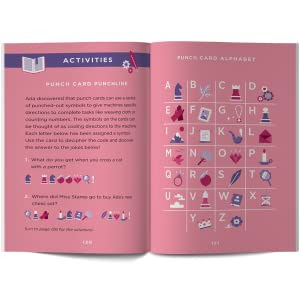
At the end of the book is a surprising section of coding activities for readers to try based on Ada's computational thinking:


The activities are all written by the Wogrammer organization that aims to increase women's accomplishment in the sciences.  They have a podcast if you want to listen to their topics.


Another notable aspect of this book are the fanciful illustrations sprinkled throughout the text.  Each chapter opens up with clues to the next part of Ada's journey so the reader can infer what could be happening next.


Finally, readers can consider the relationships that Ada formed and how those affected her life.   Starting with her mother and her absent father.  How did those change over the story?  Can readers relate to having adults in their lives push them in one direction that they don't want to explore?  Ada's relationship with Charles Babbage is also one that is relatable to many readers.  How many times have they had to work with someone on a project where they differed in their approach to the task?  Teamwork, collaboration, reaching consensus are all parts of Ada's story that connect to our lives today.  Readers can think about what they would do in Ada's shoes when Babbage refused to see her vision for the machines they were designing? 

This is a must-have book for elementary and middle school-aged readers because it's engaging and offers a real model of a female scientist who pushed against gender norms to pursue her interests. I'm looking forward to reading more from the Rebel Girls series to add to our biography & STEM collections.


Thursday, June 10, 2021

The House That Lou Built: what makes a home?


The House That Lou Built by Mae Respicio is an award-winning, middle-grades chapter book that is great for a book club, read aloud, or independent reading book.  It offers a unique look at the Filipino-American culture while exploring universal themes of grief, family, and friendship for a middle-schooler.


13 year-old Lou is half-Filipina, half-White but she identifies with her Filipina side since she lives with her mother's family in San Francisco.  Her father passed away before she was born and he left her some land as her inheritance.  When Lou visits her plot of land she feels at peace and connected to her father.  When her mother considers moving them away so she can find a better job Lou decides to build a tiny house on her land that she has always dreamed of building. Lolo, her grandpa, tells her, "That's how dreams work.  You just have to do them."  Perhaps this will convince her mother to keep them there?

Lou's community is an important part of the story.  Her mentors, Lolo, Annie, the salvage yard owner and shop teacher, Mr. Keller,  help her with her plans, as have her close friends and family members.  She even makes friends with the ever-popular, Jack, who she encourages to document her project.  Lou is not a typical character because she excels in building and engineering, which makes her stand out amongst her friends and classmates.  Her favorite place to be is the salvage yard because it inspires her to use the parts to invent new machines.  Readers can share a place that inspires them!  She also keeps a running 1,001 Cool Things to Build list and adds items to it, like a catapult.  Readers can add items to the list of something they'd like to build one day.

Lou's identity is an interesting theme that Respicio addresses in the story.  Lou says, "Being half and half is something I don't think about much."  Readers who are split between cultures can compare how they feel to Lou.  When Lou compares her grandparents from both sides of her family she says, "I never knew the difference between my white grandpa and my brown one because they loved me the same." Readers can discuss differences between their family members.  Lou describes her White and Filipina features noting that she doesn't look like her mom but "Mom knows that inside, I'm just as Filipina as she is.  We connect with each other no matter how different we look."  Readers can consider to whom they feel most connected in their lives.  Lou also compares her experiences when eating meals at non-Filipino households.  Readers can share about times when they were exposed to cultures outside of their own.

I enjoyed this story in many ways.   I learned about the Barrio Fiesta and how homes in the Philippines could be moved if flooding were to occur.  Readers can learn about the trials that immigrants endure when moving to the U.S.  I loved Respicio's description of the foods, dancing, and community in the story.  It reminded me of my own Persian community of ex-Pats growing up in Kansas.  

Readers will want to stick with Lou all the way to the end to find out if she ends up building her tiny dream home or if she has to follow her dad's advice she read in his journal, that "sometimes plans change."
Readers can also explore the Tiny House Movement and design their own as an extension idea.  

She has a strong outlook and jumps over the hurdles the adults put in her way.  My favorite line is when she says, "Sure, I'm only 13 but my ideas matter."  When I taught middle school students, this was the feeling that students said frustrated them the most, that they weren't being heard.  Readers can share what is important to them, just like Lou.


Sunday, May 23, 2021

Accidental Lessons in Gender Inequity in Asia: Ruby's Wish & Ten Little Dumplings

 Every year I share books that show celebrations of the Lunar New Year. This year I came across the picture book Ruby's Wish by Shirin Yim Leos (Bridges) and illustrated by Sophie Blackall and wanted to use it for reasons beyond how the family in the story celebrates.  


It is a fictional story that is based on the author's grandmother, who while growing up in China, aspired to attend university but was not expected to because she was a girl.  


I asked students to first consider how people celebrate holidays around the world and we found similarities between their ideas and how Lunar New Year is celebrated.


We watched a clip and looked through the photos from the Sacramento Bee about how Asians in America celebrate: 


Finally, we read Ruby's Wish and I asked students to think about these points before they listen to the story:


After listening to the story, students used a template in Seesaw to respond to the questions. Students were shocked to learn about the gender bias against females and wanted to learn more.  They wondered if this was still happening, what other countries did this exist, how people were trying to change that mindset worldwide.


This led me to be on the lookout for more books that portray this gender inequality and I found Ten Little Dumplings, a picture book by Larissa Fan and pictures by Cindy Wume.


This is a book, again, based on the author's family, except this time this story takes place in Taiwan.  One boy is supposed to bring great luck to a family and this family has ten sons!  In the end, the reader finds out that the family also had a daughter. It's told from her perspective so the reader wants to go back from the beginning and see if they can spot her in the beautiful illustrations.  


Fan writes at the end that she wonders about "who is left out of the stories we are told and why.  Ten Little Dumplings is my attempts to reveal another viewpoint to a traditional tale, to write in someone who has been left out."  This would pair well with my students who heard Ruby's Wish and they can compare the stories with one another.  This could also launch an inquiry unit for students to go out and seek answers to their wonderings about gender inequality in today's world.  Whenever I share with students the gender inequality in various other parts of the world they think I am talking about hundreds of years ago, not modern-day times.  Stories like these will open up the minds of our students as they explore their thinking about this important issue.

If you've had lessons or used books on this topic with children and middle schoolers, please add your titles and ideas in the comments.  


Sunday, May 2, 2021

Know your worth: Brother's Keeper


Brother's Keeper is a middle-grade, award-winning, historical fiction debut novel by #ownvoices author, Julie Lee.  It is partially based on the experiences her mother had while growing up in North Korea in the 1940s and escaping the harrows of war by journeying to South Korea for a better life in 1950.  This is a tale of survival and family, but also it's an emotional perspective on negative gender stereotyping and what it was like for North Koreans living under Communist rule.  There are lots of topics for further study and discussion questions that readers can use for book clubs.

12-year-old Sora lives in a North Korean village with her parents and two younger brothers.  She was just told by her mother that she would have to stop attending school in order to stay home and take care of her brothers while her parents work in the fields.  She knows that this is a cultural expectation, however, that doesn't stop her from wanting to pursue her studies, especially, writing.  It also doesn't make her feel better when her parents and neighbors constantly praise her brothers only for their gender.  This pressure for her to learn proper cooking in order to marry well in a few years causes great anxiety in Sora and a rift forms between her and her parents.  

Life under Communist rule adds strain to their daily lives.  As the war gets closer to their village, Sora has flashbacks of when a family member was arrested and imprisoned for helping people cross the border into South Korea.  The risk of her father being forced to join the Communist army is so high that they even bury him in a hole in the ground for months so he stays safe!  Only when the bombs start dropping on their village is it the sign they need to flee.  Sadly, Sora and her 8-year-old brother, Youngsoo, get separated from their family and it is up to Sora to keep them alive and make the difficult decision to continue trekking south toward freedom. As Sora dreadfully thinks when Youngsoo asks her how they will cross the river without a bridge, "I didn't know, and I didn't trust myself.  Yet every decision was up to me--our lives depended on it."

Since the book opens up with a map of Korea and their journey on foot and train is marked, the reader knows that they both do make it to their final destination even before reading a single word of the book.  That is a relief, except the reader knows that this is only Sora and Youngsoo's journey and that it doesn't include their family members who the readers get to know so well throughout the story.  


Lee also divides the book into 3 parts: Home, Escape, and Busan.  This helps the reader get ready for what is to come in the most basic sense.  Lee describes their tribulations with such brutal detail that it was hard to continue reading at times.  War is difficult for everyone and Lee brings that gruesome truth to light when documenting Sora and Youngsoo's journey.  In one way, their escape contains all of the parts of a survival tale: cold, fatigue, hunger, lice, attempted kidnapping, even being driven to theft of food and begging for money for medical attention for Youngsoo.  In another way, after they reach their destination, it is a whole other type of survival for Sora.  She must go back into the gender expectations by learning how to cook, clean and take care of a house so she can be a good wife soon.  

As a teacher and librarian, I would use this book to discuss a range of topics.  First, readers can consider how the talk of gender affects children.  In one scene, Youngsoo confides in Sora of his discomfort with being the first-born son.  He says it is too much pressure for him.  This surprises Sora.   What do readers think about this revelation?  Should Youngsoo speak up when his parents and neighbors put-down Sora and insult her because she is only a girl?  How do we see these gender stereotypes reinforced in American culture?  In another scene, a young woman encourages Sora to make sure that she looks after herself first, then her brother. "Know your worth."  This advice brings tears to Sora's eyes because she had always been told to be the martyr and do everything, at whatever cost, to keep her brothers alive and well.  What do readers think about this advice?  Why do we need others to give us pep-talks like these?  Who is someone that readers have in their lives whom they can give this type of advice?

The book ends with several sections that lead to further study and discussion for readers.  First, there is an Author's Note where Lee describes all of the fiction and non-fiction parts of the story. Here is a video of Lee explaining her family's connection to the book:


There is also a section for photos from Lee's family during this time period.


Another section is a glossary of Korean words and finally, a timeline of the Korean War. 


Readers can dive into these and the story is instantly enriched. TeachingBooks.net has a free discussion guide to use, too.  I had never read a book from the Korean perspective during the 1950s and it has made me curious about other people's experiences during this time period .  As Lee writes in her Author's Note, "the stories of refugee survivors remain largely untold..."  

First loves & secret identities: A Season for Falling

 A Season for Falling by award-winning author,  Kate O'Shaughnessy,   is a young adult, realistic fiction romance book that goes deeper...