Search This Blog

Showing posts with label art. Show all posts

Monday, April 17, 2023

Understanding the misunderstood worm


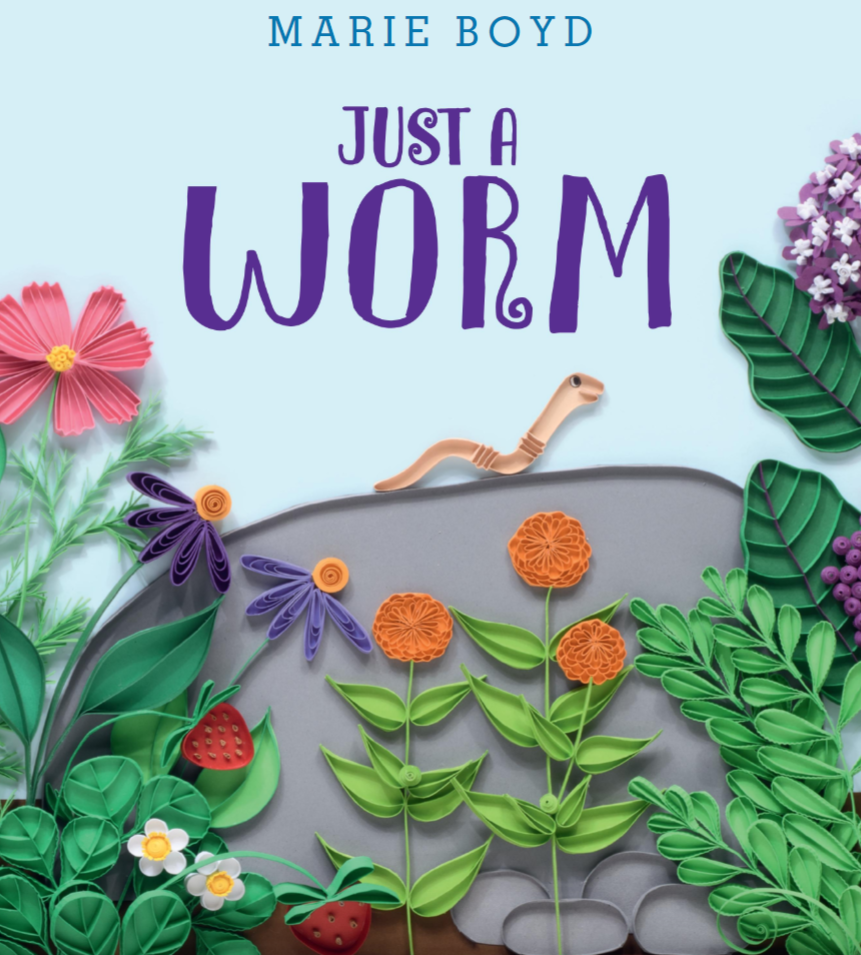
Spring is in full force and as people tend to their gardens, one animal that inevitably pops up is the worm.  Love them or hate them, they are here to help the earth in many ways.  As a teacher, parent and librarian, I seek out picture books to help young people understand the why behind creatures in nature so Marie Boyd's debut story, Just a Worm, does exactly that! Other than the sweet story of a worm, Boyd also has illustrated the book with an artistic paper cut technique called, quilling. You can learn more about her craft on her website where she has a tutorial on how to make a snail! I am excited to share this with my students and daughter. 

I had some questions for Marie Boyd regarding her book, its topic, her inspiration and other topics. Here are her responses: 


1.    Why did you decide to write about a worm of all creatures?


Hi Fallon, Thanks so much for having me on The Story Spectator! I’m excited to be here. I decided to write about a worm because when my son was younger, I often told him “It’s just a worm” when he saw worms on the sidewalk. One day I started thinking about how a worm might respond if it could understand my words. That question led to my debut picture book Just a Worm.


2.    What do you hope readers will gain after reading your book?


In Just a Worm, after being called “just a worm” by two children, Worm embarks on a journey through the garden to prove them wrong. Along the way, Worm encounters several insects and other creatures, each of which has important qualities. But what can Worm do? I wrote Just a Worm for everyone who has ever compared themselves to others and felt that they have fallen short. I hope that Just a Worm will encourage readers to consider the special ways that they contribute to their families and communities.


3.    How did you get into quilling?


I learned about quilling by chance. I was at a craft store buying fabric when I came across some quilling supplies. I didn’t know what quilling was, so I looked it up on my phone. I was intrigued by what I saw and bought the supplies. I started quilling cards for my family and friends and quickly fell in love with quilling. I had a lot of paper that I had collected over the years for various craft projects so eventually I began cutting my own quilling strips. That opened so many new creative possibilities, and eventually led to me using quilled paper to illustrate Just a Worm.


4.    What came first, the words or the illustrations?


The story started with the phrase, “it’s just a worm,” but when I thought about what Worm’s garden would look like I imagined it quilled.


5.    Do you have a special experience or memory with gardens?


I have so many special memories with gardens and the illustrations in Just a Worm draw on some of those memories. As a child, I often helped my parents in the yard and many of the plants in Just a Worm are inspired by plants from their garden.  I love gardens so much that I got married in a garden.


6.  What advice do you have for people who think worms are gross?


Worms play an important role as decomposers and it is possible to appreciate worms and what they do from a distance.


Thanks again for hosting me and allowing me to share a bit about Just a Worm. If your readers are interested in learning more about how I illustrated Just a Worm, I share quilled crafts and more on my website at www.marieboyd.com. Happy reading! 


The book, Just a Worm, is released by Greenwillow, an imprint of HarperCollins, on March 14, 2023, so you can get it now!   A big thanks to author Marie Boyd for taking the time to speak with me about her first picture book.  I hope to see many more of her works in the future. 
 

Tuesday, January 10, 2023

Poetry: the art of language


April is National Poetry Month, but the art of language is to be celebrated all year long.  When my students first hear that we are going to study poetry, many groan, unsure of what is to follow.  Thankfully, after these engaging and creative ideas, they change their perspective to one that celebrates the various forms and topics that one can express through the art of language.  

Shape or Concrete Poems:  a poem that takes the shape of its subject matter.  Some books that help illustrate this are:


First, we read several concrete poems and students form the definition for a concrete poem.  Then I take them through a group writing experience where we brainstorm a list of items they generate. Then we take one and I loosely sketch an image that is associated with that. Then we come up with descriptive words, feelings, similes, metaphors, and analogies to write our ideas in the borders of the shape.  Students who are able can try this out on their own, or for those who need scaffolds you can provide the outline of various shapes along with vocabulary for students to cut out and glue to form their concrete poem.  

Blackout Poetry:  this is when writing that has already been published is used as inspiration for carving out a poem from those words already printed.  The poet can circle those words they wish to use and black out the rest of the words through patterns, other colors, or by blacking them out.

Rather than use books for this I like to use images from Google to show examples of blackout poetry and ask students to tell me what they notice about the poems.  

Note: I used to use newspapers for this, however, I had to be careful about the subject matter, vocabulary and layout of the articles in comparison to the advertisements, so ever since those experiences I have turned to using pages of discarded or weeded books to give to students for this type of writing.

Homophones, homonyms, idioms, puns:  poetry doesn't have to be lyrical or rhyme. Poetry can be the juxtaposition of words with multiple meanings and clever sayings explained in literal terms.  My students enjoy exploring this aspect of language because it is in small bites rather than long poems to analyze or just rhyming poems meant to  entertain.  Some books that we study during this topic are:


A video that my students like to watch and sing along with is below:

Poetry Slam:  lyrics of songs and poems are meant to be heard aloud, therefore, I invite students to read or recite poetry or songs aloud in front of an audience or if they'd rather, record and edit a video of their poem or song on a video production application, like Apple CLIPS or iMovie.  Students should be given time to find a poem or song with which they connect and choose to share it with others. For the Poetry Slam experience, I hang twinkle lights up, spread out picnic blankets and a variety of flexible seating options around as the lights dim and we can enjoy one another's love of language.  

Book Spine Poetry: this is one of my favorite types of poetry to share with students. First we look at a variety of examples and students form a definition for what is included in a book spine poem.  Then students are sent in partners or small groups to a certain part of the library to create their own book spine poem.  I ask students to take a photo of their poem on their device so that I may project it for the class, but they also like to display their book spine poems for others to read.  The best part of this experience is that students always find books that they want to read that they may have never even chosen if not for this opportunity to look for interesting book titles. 


An extension of this is to add music or other effects to the mood of their poems using a collage of photos or a technology application, like iMovie, FlipGrid, Seesaw, or Apple CLIPS.

Although some librarians hesitate to use book spine poetry with students due to the large amount of shelving that will follow the experience, Mike Rawls, a.k.a. The Book Wrangler, suggests using paper spines with book titles already on them or you can photocopy.  

Novels-in-Verse: a story written in verse is one of my favorite formats to share with students. Much like a chapter book or graphic novel or picture book format, a novel-in-verse is another way that writers tell a story, but in lyrical form.  

Do you have a favorite way to share poetry? Please leave a comment below!


Tuesday, January 11, 2022

Author/illustrator Spotlight: Steve Jenkins


I didn't envision my first blog post of 2022 being in honor of someone who has passed away, but here we are.  The world lost an artist today whose work will go on to resonate with readers forever.  Steve Jenkins has been my go-to nonfiction author and illustrator the entire time that I have been in education.  His picture books spark curiosity, conversation and always lead to students sharing stories about themselves.  In his 80 books he has published, Jenkins focused on scientific topics found in nature and presented those in brightly formed paper collages that look like photographs, they are so well done!

Usually my second grade classes have the chance to study Jenkins' work for several weeks and from then on they can always be found returning to his books, like old friends, again and again.  I first present Jenkins and his wife and work partner, Robin Page, and with students we explore his website that has his book covers on a virtual bookshelf.  


As I scroll through the virtual bookshelf, students help me read the titles, we discuss what they notice about the cover designs and they share if they have seen or read the books before.  Then I show them what books we have in our library collection and they are eager to get their hands on them.  I read aloud from the ones they react to the most. We pass them around and as the students browse they show one another what they find interesting and even try to call dibs on what book they want to check out.  


Finally it's time for students to pick a book that inspires them to create a collage in the style of Jenkins.  We watch a video of Jenkins working and we describe together what he is doing.  As the students notice that he first creates a rough sketch, then using his sketch he makes a larger version with glue and layers of paper.  They cannot wait to dive in and try it themselves!  


For further extension, I've had students use an online encyclopedia or website to add facts to their collage.  Other students add more details in terms of background images and additional scenery to add to the setting.  Some write poems and stories inspired by their collage.  Others simply enjoy looking at what their classmates created and showing them what they made.


I hope that this gives some teachers, librarians, and families ideas for how to use Steve Jenkins' books with their children and students. I know that I will continue to do so, year after year, not because he is an award-winning illustrator, which he is, but because he makes learning memorable for readers of all ages.  


Saturday, October 2, 2021

Hispanic Heritage Month Ideas


September 15 - October 15 is Hispanic Heritage Month and although we need to share Latinx voices all year round, this is the month that we can bring all of their books together in one place and celebrate.  Over the years I have done school-wide books and other times we focus on author studies for each grade level:

Kindergarten-1st grades: Juana Martinez-NealMatt de la Peña

2nd-3rd grades: Meg MedinaYuyi Morales, Pat Mora

4th-5th grades: Gary Soto, Duncan Tonatiuh, Pam Muñoz RyanMargarita Engle

Here are some specific books with lesson ideas:

Kindergarten - 1st grades


Prior the read aloud teach students how to say donkey in sign language. share that the author and illustrator, Anuska Allepuz is originally from Spain, and have them predict what the donkey eats that turns it green.  
After reading, go over the difference between fiction and nonfiction. What do they think this book is and why?  


Have the students choose a food for the donkey to eat and color their donkey the color of that food.  Students can also write the food and color on the template.


Before reading Moon Rope by Lois Ehlert, share that folktales often have a lesson and that this story is from Peru.  Review the animals that they will encounter in the story and have them act out the motions of the animals while they listen.  


After the story give each child a page with pictures from the book.  For example, here is one I provide:


Ask them to cut out the pictures and arrange them in order. They can number them or tape them to a piece of yarn for the full "Moon Rope" retelling experience.


Feel the Beat by Marilyn Singer and Let's Dance! by Valerie Bolling feature dances from Latin and South America.  Feel the Beat has a CD that comes with it, so students can listen to the poem with music.  Let's Dance can be read then students can get up and dance to Latinx music.  If you have shakers and maracas it's even better!
Here is an audio sample of Feel the Beat. 


2nd-3rd Grades


Mango, Abuela, and Me by Meg Medina and Angela Dominguez is perfect for making predictions and having students discuss all of the ways someone who speaks another language could feel.


Students share the words that they know in Spanish and learn the sign language for parrot. before listening to the story.   During the reading I like to share a prop of a suitcase with a snapshot and red feather like Abuela shares with Mia.  Students like to handle the objects after they hear the story.  Once the read aloud is complete, students can discuss the ways that language pushed the characters apart and how they were brought together.


As an extension of the book, students can make their own parrots out of paper or other STEM building materials.


Dreamers by Yuyi Morales is a beautiful story to share with students.  I ask students what it is like to move to another country.  Students discuss the wide range of feelings an immigrant could have.   Prior to reading the book we listen to Morales give background on her story and what her drawings symbolize.


After listening to the story, students brainstorm what gives them their identity.  Then they write a bio poem on a template provided by the teacher. You can get it HERE.


All the Way to Havana is a special picture book by Margarita Engle and Mike Curato.  Students get to learn about Cuba by listening to the author's note about how prior to 1959 there was a car ban in the country.  

There's a great trailer show:


As the book is read, it's really a poem, so the students can chant the sounds they hear.  After reading the story students can build a car of their design using the materials in their STEM bins.  When they are finished they can walk around and look at each other's creations.  TeachingBooks.Net also has an audio clip of Curato explaining how he went about creating the illustrations for the story.


4th-5th Grades


Students may recognize the skulls or caleveras from the movie Coco and associate it with The Day of the Dead.  Ask the students how it became so popular and invite them to listen to biography picture book, Funny Bones by Duncan Tonatiuh.  I give students a biography graphic organizer to use to write their notes and sketch their images.  


Students can listen to Tonatuih on TeachingBooks.Net explain his process for creating the illustrations.

After reading the story students can try to make their own calaveras out of paper plates. HERE are the directions.


Other books by Duncan Tonatiuh that I like to share are Separate is Never Equal and Dear Primo: 


Frida, a picture book by Jonah Winter and Ana Juan, is a beautifully told and illustrated story about artist, Frida Kahlo. Since I use this book with older readers I like to use the idea found on Common Sense Media  called, Queen of the Selfies.  Prior to reading the story I ask students to define what a selfie is, what makes them like or dislike one and how long they think selfies have been around.


Then I ask them what they know about Frida Kahlo:


We look at her self-portraits and try to guess what her life was like:


We read the book aloud and go back to her paintings to find clues to what she endured:


Finally, students are challenged to create a self-portrait using Frida's style of including important feelings, objects, and symbols. We use the app PicCollage on our iPads to do this. Here is my example:


Gary Soto's book of poetry, Neighborhood Odes is excellent for this age group.  Prior to reading  the poems, students brainstorm ideas from their neighborhood, family, friends, or objects they own.


I share that in Neighborhood Odes, Gary Soto focuses on these categories.  I challenge the students to try to match up the titles of the poems and the papel picado cutout-illustrations based on clues.  


Then I show them Soto's news story about the museum that opened in his honor:


We read one of his poems, "Ode to Pablo's Tennis Shoes" and students underline the parts that stand out to them.  They pick something from their brainstormed list and write an ode or a story about that idea.


As an extension we read his poem, "Oranges" that was made into a short film. After we read it, we watch the video and compare and contrast it to the poem.  


If students want to read a picture book by Soto, I recommend Too Many Tamales:


Shannon McClintock-Miller has created a Choice Board for students to explore, as well. If you have more titles you suggest please leave them in the comments!


Sunday, September 5, 2021

The Mushroom Fan Club: putting the FUN in Fungi!


 The Mushroom Fan Club, a nonfiction picture book written and illustrated by Elise Gravel is a delight for all of the senses.  We have Gravel's popular nonfiction  Disgusting Critters series   in our school library and it's highly popular with our students, so when I spotted this book in our local comic book store, Chops Comics, I knew I had to take a closer look!

Gravel takes the reader along with her and her daughter as they venture into the woods looking for some mushrooms. She adds diagrams that help readers learn the names of the parts of the mushrooms and differentiates among popular types they have encountered on their hunts.  


The best part is that Gravel brings personality to the mushrooms so readers can remember the information, connect with it and share what they've learned with others.  I am going to use this book with my kindergarten - 2nd grade classes when we are working on the difference between fiction and nonfiction.  I've used her book, The Fly, for this learning objective before and the students love to listen to the facts about flies, which they see everyday.  

The Mushroom Fan Club offers many opportunities for interactive listening and follow-up activities.  My favorite parts of the book are that there are actions that readers can do along with the mushrooms.  For example, Gravel's daughter stomps on puffballs to help spread their spores for reproduction, so readers can act out stomping, just like her daughter.  


There are also species of mushrooms that Gravel does not get to describe, she leaves only the attention-grabbing names.  Readers can choose one to research, illustrate and share a fact with the community.  Or they can draw what they think the mushroom would look like based on the clues in the name and then they can look up the actual one to see how close they were!


Readers can, of course, walk outside and look for mushrooms as a follow-up and document what they have found.  They can learn about what mushrooms grow in their area.  We are lucky in our town to have a mushroom hunting club and at our farmers' market, many mushroom growers who are happy to share their knowledge about mushrooms.


Finally, Gravel adds instructions on how to do a spore print which is perfect for a classroom art activity.  All you need are mushrooms, paper and a glass or bowl. 


 I'm looking forward to reading this book with my students and encouraging them to get outside to look for mushrooms.  I'm incredibly impressed with anything that Gravel has written so I feel lucky to have found this copy nearby! It's a must-have for school libraries, science classrooms and home libraries.


Thursday, July 22, 2021

Ancestor Approved: a Native Voices anthology


Ancestor Approved, a middle grades anthology of short stories and poems edited by Cynthia Leitich Smith is a book that presents a wide range of Native people's experiences attending a big pow wow in Ann Arbor, Michigan.  Each story takes on a unique point of view, even a rez dog!  What stands out is the variety of what it means to be Indian for each individual person.  Traditions are universally respected, but each character's background results in a plethora of feelings to be explored:  from apprehension about dancing, meeting family for the first time, to not feeling Native enough because of being so far from a rez and being adopted by White parents, jealousy even, from not being good at beadwork, and of course, the pride of being part of a large community.


As a parent, educator, and librarian, I think this book would be perfect for a community common read.  The writers in the anthology are incredibly detailed in their storytelling and are all authentic in their depiction of characters.  Every reader can find so much to discuss in each story and poem.  The best parts are the extensions that result from the references made in each story.  If a reader is interested in the mythology, they can do more readings upon that topic.  Or if someone is more into the music and dance side, they attend a pow wow and see firsthand what it is like.  The cuisine is also deliciously described. Readers can try fry bread, Navajo tacos, and other tasty treats from the book.  I also like how there is a critical view of stereotypes of how Native people are portrayed in the media and books.  Readers can find more examples of this and learn about ways to curb those images.  Finally, I especially appreciated the way some of the authors included how schools often make Native students feel as the other, tease and bully them.  Each of these instances is an opportunity to discuss with students if they have ever faced those moments and how to help one another because words and actions have life-long effects that can harm people.  


At the end of the anthology there is a glossary for correct pronunciation of words used and each author shares a bit about why they chose the topic they did.  This is the perfect chance for readers to read other works by the authors included in the anthology.  

Ghost in the Night: a spooky story for preteens

  Ghost in the Night by award-winning author, Tiffany D. Jackson, is a middle grade chapter book that is perfect for readers who want an in...