Search This Blog

Showing posts with label STEM. Show all posts

Tuesday, May 30, 2023

Creative ways to end the school year


The end of the school year marks a unique opportunity for educators to create lasting memories with students. If you aren't able to try any of these activities out this year, keep them in mind as beginning of the school year rolls around or use them at the close of next year.

STEAM challenges

  • Students choose a book, either a new one or a past read that they enjoyed.
          They must create an object that goes with the book. Then they share the story and what they chose to create with their classmates. These can go on display or be taken home, depending on the materials used with the books. 

Pictured here are my students using LEGO blocks:


Students were challenged to build a troll bridge out of LEGO blocks. I gave them a piece of blue paper as the water and the only stipulation I made was that it had to be elevated, not touching the water.  As the students worked they found that they wanted to continue the challenge with more requirements, like the ones that are the sturdiest, tallest, etc. 

The best part was listening to them share their strategies for building and helping each other when they got stuck. It also inspired some to want to perform a reader's theater of the story! 


  • Put up a big Spot the Difference to complete as a class. Then challenge students to make their own and trade with one another. They can use old magazines to cut out pictures and words or use Google Slides or another digital format to make their pictures. 
The one shown in this video is from the publisher's website for the book, Someone Builds the Dream by Lisa Wheeler and Loren Long. 


  • Challenge students to create a BookFace photo. They will need access to a camera and book covers You can do this with book covers that are already separated from books or from the books themselves. In small groups, 3 people is usually good, students select a book cover that they can finish with their own bodies, faces, or other objects. Then students pose in a way that aligns with the book's cover art and another student takes the picture. Pictures can be edited and cropped so that only the BookFace remains.  Here are some of our favorites from this past year:


Blast From the Past

This is a fun way to look back on the school year and reflect on those moments of growth, humor, and classmates who have come and gone.  

  • Show photos and ask students to recall those lessons. I also record or have them write down what they are interested in at the start of the school year.  At the end, I share with them what they said and ask if anything has changed since then.  It is so neat to hear how their interests and lives change.

  • Roll videos produced by students, for example, stop motion films, book trailers, etc.  After looking at some, students asked to make more next year and for specific events, like, Talk Like a Pirate Day.  We even made several of our own as a class on our last library day!


  • Have students rank their top reads of the year. Our library management system allows them to see their circulation history, so students were able to rank their favorite books they checked out. 


Looking ahead
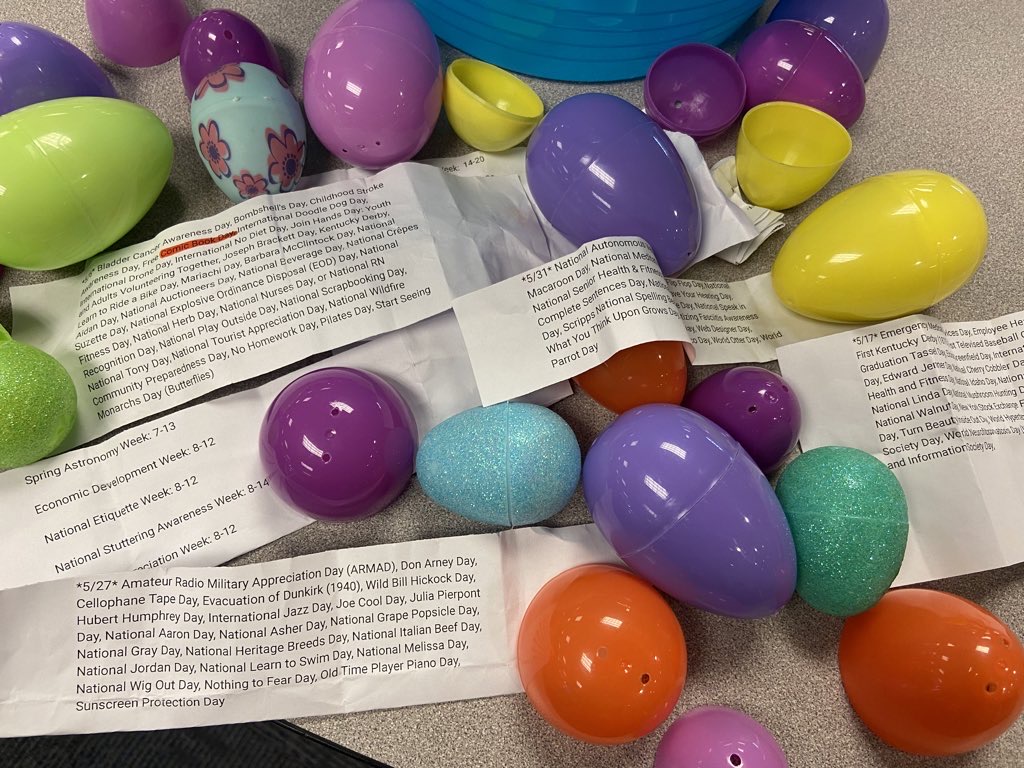
  • Share with students special days, holidays, or hide them in plastic eggs around the room. (I got the list from LM_NET and had to cut some out due to the age of my students.) Students select one to learn more about and then share with their classmates what they learned. You can have them write it on a sticky note, make a poster, or a digital copy.
This poster displayed here is from my Capstone Publisher representative:


  • Survey students about their opinions about the library program or your classroom.  I've had students use devices to fill out Google Forms and I've had them write their ideas on paper posted around the room.  This helps to shape the next year and gives students a voice:


Play unplugged games

  • Peep Knock-out: you take turns with a partner trying to knock a Peep off of the side of a table using only a plastic egg that you roll.  I heard about this game from a librarian colleague of mine and was waiting to play it on a special occasion. My 1st graders played the game and then we came together to critique it and adjust the rules for playing it again in the future. 


  • "Water Balloon Battle" or "________ Battle": You take turns launching a balloon on paper towards your opponents figures, also drawn on paper.  Your eyes are closed when launching and if you hit the figure then you succeed.  I first saw this on a fellow librarian's Twitter account and had my students play it, they loved it!  They also had fantastic ideas for adjustments.  
    • Follow the directions below for the rules to the tabletop game: 
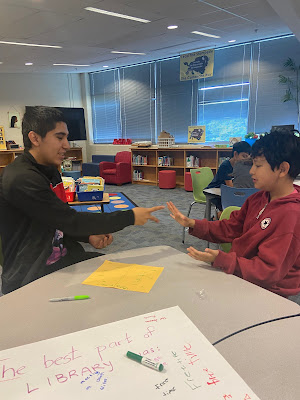
Of course there are so many fun ways to end the school year or engage with learners to build community, please leave your favorite activities in the comments or if you have specific questions, send them my way.


Friday, January 21, 2022

Stuck & Solving for M: where do children get help?


Teachers make the best writers when it comes to capturing the feel of school.  Former educator, Jennifer Swender, completely strikes a chord of authenticity in her two middle grade novels: Solving for M and Stuck.  Each of these is told from the point of view of a student who is going through a tough time. Although each story is about a different child, the feelings, reactions, situations and people who are there to help or hurt, is realistic.  As a teacher, I think school stories can truly help improve my practice, especially in areas where trauma and other learning insecurities come into play.

 In Solving for M, the main character is a 5th grader named Mika who is just starting middle school.  Her favorite subject is art but she's surprised to find out that her class is heavier on art theory than actual art creation.  On the positive side, her math teacher is unlike any teacher she's ever had. He teaches with outside-the-box approaches and asks everyone to keep a math journal.  Mika's journal is her outlet to not only show that she understands the math concepts, but she connects everything to the news that her mom may have cancer.  Through drawings and writing down her feelings, Mika is able to get through the difficult year and that's all thanks to her teacher who noted what his students needed and followed through in a memorable way.

Solving for M won the Mathical Book Prize in 2020 and is nominated for the William Allen White Children's Book Award in Kansas for the 2021-2022 school year, along with more accolades!

Swender's newest book, Stuck, is a slim read compared to Solving for M. At only 133 pages, this story is from the perspective of a boy named Austin who is just finishing 4th grade at a new school right at the end of the year.  He's used to making up lies about why him and his mom move so much and he's ready to do it all again in his new school, except there are several people who welcome him without asking any questions: his new teacher and a classmate.  This is an interesting read because Austin tries to hide his reading disability in clever ways that I'm sure other teachers will recognize.  His relationship with his classmates is unique as he tries to figure them out based on their behaviors. One classmate receives special education services and support and Austin studies him the most trying to figure him out.  Over the course of his time he discovers that he wants to be a leader and to try out for their school's safety patrol. He wants to be looked-up to and it will take his friends and teacher to help him get there.  

I liked Stuck because of Austin's personality which is something not often seen in middle grade literature.  Many readers will be able to identify with Austin's neurodiversity and educators and parents can use his perspective to gain more empathy for others like him.  

Both of these books would be smart additions to elementary and middle grade classrooms, libraries and homes.  Austin and Mika's stories deserve to be told, shared & discussed!

And the Stuck cover doubles as a cool Book Face for #BookFaceFridays !


Sunday, November 28, 2021

Last Night at the Telegraph Club: a Young Adult historical fiction coming of age tale


Last Night at the Telegraph Club the 2021 National Book Award for Young People's Literature written by Malinda Lo is a story that has yet to be told in the arena of young adult literature. Lo deserves the award for her portrayal of Lily Hu, a 17 year-old Chinese-American daughter of immigrants who settled in Chinatown in San Francisco.  The year is 1954 and the Red Scare is is buzzing all around Lily and her community. She must be careful with whom she associates or else it could spell trouble for her family.  What ends up happening not only affects Lily's future, but also those around her.  

With the tone of a coming of age story, Lo reminds the reader of what it's like to be a teenager trying to figure out who you really are.  When Lily sees an advertisement for The Telegraph Club with a male impersonator or cross-dresser, something in her is awakened. She feels drawn to the club and finds a fellow classmate, Kath, who has an in there.  Once Kath introduces Lily to the club and the people inside, a whole new world opens up for Lily.  A world where others who feel like her can feel normal.  How can Lily return to the person her family expects her to be after she's discovered her feelings for women?  

The best part of this story is when Lo uses the flashbacks between Lily's storyline with ones about her parents and her aunt.  Their own circumstances and journeys to the U.S. to where they are in the 1950s sheds much light on their actions.  As I read the story I kept telling myself if Lily only knew her own family's struggles with their identity in the U.S., then she could open up to them about her own apprehension about where she stands.  

As a former history teacher, I also enjoyed the timelines that Lo includes that show the year, Lily and her family's major moments, and parts of world and American history that have affected Chinese Americans since they were first brought to the U.S. to build the trans-continental railroad.  As the daughter of an aerospace engineer, I enjoyed the development of the Jet Propulsion Laboratory as Lily's other passion is studying space travel.  Thankfully her aunt is a human computer for the program and encourages Lily to pursue her interest in math, science, and engineering.  This part of history is interesting for readers to compare to Katherine Johnson and her pioneering work she did for NASA.

This story is an important one for people to read who may not be familiar with the experiences of Chinese Americans.  It's also a history of how the LGBTQ+ community has had to seek out safe spaces to be themselves.  It surprised me that in the ever-inclusive city of San Francisco, there was once a time that it was illegal for homosexuals to even congregate in public.  The end of the novel is full of more information that Lo explains served as her basis for all of the storylines in the book.  Readers who are interested have a number of resources to use to continue learning about more people who lived during this time and left their mark on the country. 

Saturday, October 2, 2021

Hispanic Heritage Month Ideas


September 15 - October 15 is Hispanic Heritage Month and although we need to share Latinx voices all year round, this is the month that we can bring all of their books together in one place and celebrate.  Over the years I have done school-wide books and other times we focus on author studies for each grade level:

Kindergarten-1st grades: Juana Martinez-Neal, Matt de la Peña

2nd-3rd grades: Meg Medina, Yuyi Morales, Pat Mora

4th-5th grades: Gary Soto, Duncan Tonatiuh, Pam Muñoz Ryan,  Margarita Engle

Here are some specific books with lesson ideas:

Kindergarten - 1st grades


Prior the read aloud teach students how to say donkey in sign language. share that the author and illustrator, Anuska Allepuz is originally from Spain, and have them predict what the donkey eats that turns it green.  
After reading, go over the difference between fiction and nonfiction. What do they think this book is and why?  


Have the students choose a food for the donkey to eat and color their donkey the color of that food.  Students can also write the food and color on the template.


Before reading Moon Rope by Lois Ehlert, share that folktales often have a lesson and that this story is from Peru.  Review the animals that they will encounter in the story and have them act out the motions of the animals while they listen.  


After the story give each child a page with pictures from the book.  For example, here is one I provide:


Ask them to cut out the pictures and arrange them in order. They can number them or tape them to a piece of yarn for the full "Moon Rope" retelling experience.


Feel the Beat by Marilyn Singer and Let's Dance! by Valerie Bolling feature dances from Latin and South America.  Feel the Beat has a CD that comes with it, so students can listen to the poem with music.  Let's Dance can be read then students can get up and dance to Latinx music.  If you have shakers and maracas it's even better!
Here is an audio sample of Feel the Beat. 


2nd-3rd Grades


Mango, Abuela, and Me by Meg Medina and Angela Dominguez is perfect for making predictions and having students discuss all of the ways someone who speaks another language could feel.


Students share the words that they know in Spanish and learn the sign language for parrot. before listening to the story.   During the reading I like to share a prop of a suitcase with a snapshot and red feather like Abuela shares with Mia.  Students like to handle the objects after they hear the story.  Once the read aloud is complete, students can discuss the ways that language pushed the characters apart and how they were brought together.


As an extension of the book, students can make their own parrots out of paper or other STEM building materials.


Dreamers by Yuyi Morales is a beautiful story to share with students.  I ask students what it is like to move to another country.  Students discuss the wide range of feelings an immigrant could have.   Prior to reading the book we listen to Morales give background on her story and what her drawings symbolize.


After listening to the story, students brainstorm what gives them their identity.  Then they write a bio poem on a template provided by the teacher. You can get it HERE.


All the Way to Havana is a special picture book by Margarita Engle and Mike Curato.  Students get to learn about Cuba by listening to the author's note about how prior to 1959 there was a car ban in the country.  

There's a great trailer show:


As the book is read, it's really a poem, so the students can chant the sounds they hear.  After reading the story students can build a car of their design using the materials in their STEM bins.  When they are finished they can walk around and look at each other's creations.  TeachingBooks.Net also has an audio clip of Curato explaining how he went about creating the illustrations for the story.


4th-5th Grades


Students may recognize the skulls or caleveras from the movie Coco and associate it with The Day of the Dead.  Ask the students how it became so popular and invite them to listen to biography picture book, Funny Bones by Duncan Tonatiuh.  I give students a biography graphic organizer to use to write their notes and sketch their images.  


Students can listen to Tonatuih on TeachingBooks.Net explain his process for creating the illustrations.

After reading the story students can try to make their own calaveras out of paper plates. HERE are the directions.


Other books by Duncan Tonatiuh that I like to share are Separate is Never Equal and Dear Primo: 


Frida, a picture book by Jonah Winter and Ana Juan, is a beautifully told and illustrated story about artist, Frida Kahlo. Since I use this book with older readers I like to use the idea found on Common Sense Media  called, Queen of the Selfies.  Prior to reading the story I ask students to define what a selfie is, what makes them like or dislike one and how long they think selfies have been around.


Then I ask them what they know about Frida Kahlo:


We look at her self-portraits and try to guess what her life was like:


We read the book aloud and go back to her paintings to find clues to what she endured:


Finally, students are challenged to create a self-portrait using Frida's style of including important feelings, objects, and symbols. We use the app PicCollage on our iPads to do this. Here is my example:


Gary Soto's book of poetry, Neighborhood Odes is excellent for this age group.  Prior to reading  the poems, students brainstorm ideas from their neighborhood, family, friends, or objects they own.


I share that in Neighborhood Odes, Gary Soto focuses on these categories.  I challenge the students to try to match up the titles of the poems and the papel picado cutout-illustrations based on clues.  


Then I show them Soto's news story about the museum that opened in his honor:


We read one of his poems, "Ode to Pablo's Tennis Shoes" and students underline the parts that stand out to them.  They pick something from their brainstormed list and write an ode or a story about that idea.


As an extension we read his poem, "Oranges" that was made into a short film. After we read it, we watch the video and compare and contrast it to the poem.  


If students want to read a picture book by Soto, I recommend Too Many Tamales:


Shannon McClintock-Miller has created a Choice Board for students to explore, as well. If you have more titles you suggest please leave them in the comments!


Dasia (Forever)-a middle grade novel tackling serious topics

  Dasia (Forever) by Nic Stone , a middle grade novel sprinkled with letters in a verse format, provides a raw, emotional perspective of Da...