Search This Blog

Showing posts with label nature. Show all posts

Monday, April 17, 2023

Understanding the misunderstood worm


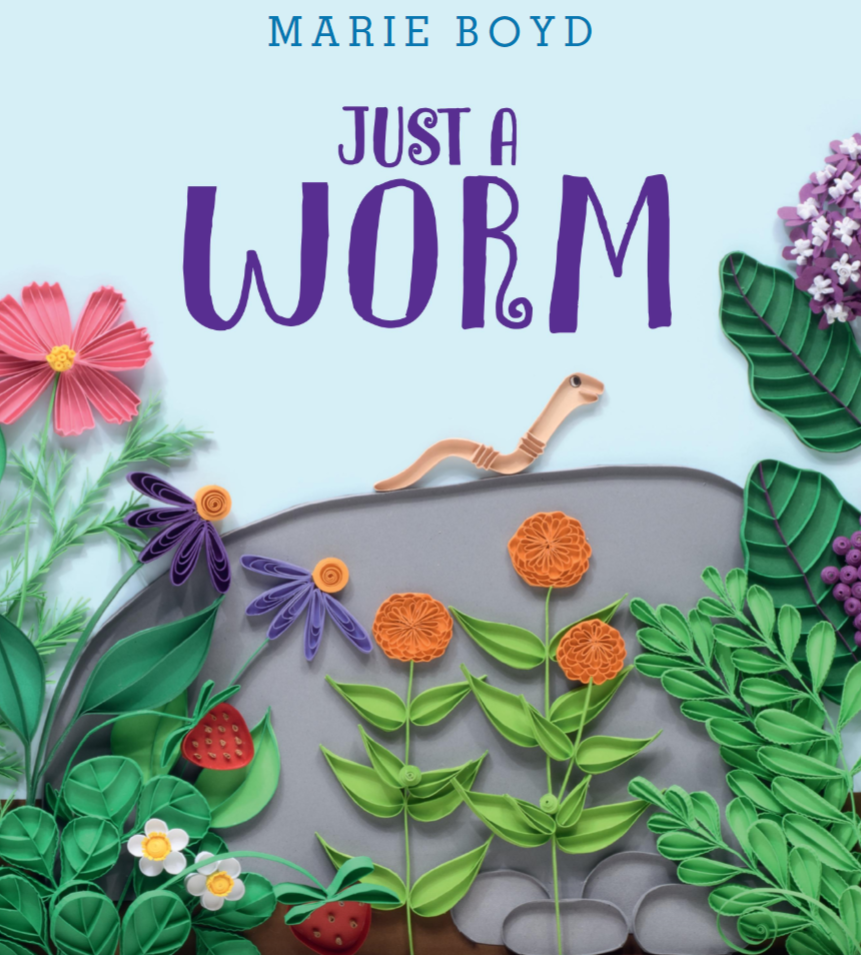
Spring is in full force and as people tend to their gardens, one animal that inevitably pops up is the worm.  Love them or hate them, they are here to help the earth in many ways.  As a teacher, parent and librarian, I seek out picture books to help young people understand the why behind creatures in nature so Marie Boyd's debut story, Just a Worm, does exactly that! Other than the sweet story of a worm, Boyd also has illustrated the book with an artistic paper cut technique called, quilling. You can learn more about her craft on her website where she has a tutorial on how to make a snail! I am excited to share this with my students and daughter. 

I had some questions for Marie Boyd regarding her book, its topic, her inspiration and other topics. Here are her responses: 


1.    Why did you decide to write about a worm of all creatures?


Hi Fallon, Thanks so much for having me on The Story Spectator! I’m excited to be here. I decided to write about a worm because when my son was younger, I often told him “It’s just a worm” when he saw worms on the sidewalk. One day I started thinking about how a worm might respond if it could understand my words. That question led to my debut picture book Just a Worm.


2.    What do you hope readers will gain after reading your book?


In Just a Worm, after being called “just a worm” by two children, Worm embarks on a journey through the garden to prove them wrong. Along the way, Worm encounters several insects and other creatures, each of which has important qualities. But what can Worm do? I wrote Just a Worm for everyone who has ever compared themselves to others and felt that they have fallen short. I hope that Just a Worm will encourage readers to consider the special ways that they contribute to their families and communities.


3.    How did you get into quilling?


I learned about quilling by chance. I was at a craft store buying fabric when I came across some quilling supplies. I didn’t know what quilling was, so I looked it up on my phone. I was intrigued by what I saw and bought the supplies. I started quilling cards for my family and friends and quickly fell in love with quilling. I had a lot of paper that I had collected over the years for various craft projects so eventually I began cutting my own quilling strips. That opened so many new creative possibilities, and eventually led to me using quilled paper to illustrate Just a Worm.


4.    What came first, the words or the illustrations?


The story started with the phrase, “it’s just a worm,” but when I thought about what Worm’s garden would look like I imagined it quilled.


5.    Do you have a special experience or memory with gardens?


I have so many special memories with gardens and the illustrations in Just a Worm draw on some of those memories. As a child, I often helped my parents in the yard and many of the plants in Just a Worm are inspired by plants from their garden.  I love gardens so much that I got married in a garden.


6.  What advice do you have for people who think worms are gross?


Worms play an important role as decomposers and it is possible to appreciate worms and what they do from a distance.


Thanks again for hosting me and allowing me to share a bit about Just a Worm. If your readers are interested in learning more about how I illustrated Just a Worm, I share quilled crafts and more on my website at www.marieboyd.com. Happy reading! 


The book, Just a Worm, is released by Greenwillow, an imprint of HarperCollins, on March 14, 2023, so you can get it now!   A big thanks to author Marie Boyd for taking the time to speak with me about her first picture book.  I hope to see many more of her works in the future. 
 

Tuesday, January 11, 2022

Author/illustrator Spotlight: Steve Jenkins


I didn't envision my first blog post of 2022 being in honor of someone who has passed away, but here we are.  The world lost an artist today whose work will go on to resonate with readers forever.  Steve Jenkins has been my go-to nonfiction author and illustrator the entire time that I have been in education.  His picture books spark curiosity, conversation and always lead to students sharing stories about themselves.  In his 80 books he has published, Jenkins focused on scientific topics found in nature and presented those in brightly formed paper collages that look like photographs, they are so well done!

Usually my second grade classes have the chance to study Jenkins' work for several weeks and from then on they can always be found returning to his books, like old friends, again and again.  I first present Jenkins and his wife and work partner, Robin Page, and with students we explore his website that has his book covers on a virtual bookshelf.  


As I scroll through the virtual bookshelf, students help me read the titles, we discuss what they notice about the cover designs and they share if they have seen or read the books before.  Then I show them what books we have in our library collection and they are eager to get their hands on them.  I read aloud from the ones they react to the most. We pass them around and as the students browse they show one another what they find interesting and even try to call dibs on what book they want to check out.  


Finally it's time for students to pick a book that inspires them to create a collage in the style of Jenkins.  We watch a video of Jenkins working and we describe together what he is doing.  As the students notice that he first creates a rough sketch, then using his sketch he makes a larger version with glue and layers of paper.  They cannot wait to dive in and try it themselves!  


For further extension, I've had students use an online encyclopedia or website to add facts to their collage.  Other students add more details in terms of background images and additional scenery to add to the setting.  Some write poems and stories inspired by their collage.  Others simply enjoy looking at what their classmates created and showing them what they made.


I hope that this gives some teachers, librarians, and families ideas for how to use Steve Jenkins' books with their children and students. I know that I will continue to do so, year after year, not because he is an award-winning illustrator, which he is, but because he makes learning memorable for readers of all ages.  


Thursday, June 17, 2021

Wilderlore: The Accidental Apprentice, a magical adventure


Wilderlore: The Accidental Apprentice, a middle grades fantasy chapter book by Amanda Foody is perfect for fans of Harry Potter and The Girl Who Drank the Moon.  


Barclay is an orphan who wants to belong so badly that he's willing to be the apprentice of a mushroom farmer in order to have a decent shot at a respectable future in his sad, paranoid town of Dullshire.  The townsfolk have strict rules and are protecting themselves against the magical and dangerous beasts that lurk in the woods. (The same ones that killed Barclay's parents.)

When he accidentally bonds with a mysterious and wild beast, Barclay will stop at nothing to try to get back to his old life.  His journey will take him deep into the woods to an unbelievable world of power, lore and untrustworthy types who take advantage of Barclay's naiveté and eagerness to remove his bond.

Viola, a lore keeper who seeks out dangerous beasts, offers to help Barclay.  He is unsure whether to trust her and her little dragon beast, Mitzi, or not.  With a magical competition starting that could be Barclay's ticket to return to Dullshire, he must risk everything.  Will he finally find a place in the world where he belongs in the magical wild or will he go back to a lonely, ordinary, yet, safe life in Dullshire?

A humorous mystery full of action, imagination and memorable characters. This is a must-have for middle grade readers who enjoyed fast-paced, fantasy adventure with loads of funny banter and a hint of mystery.

Families, librarians and teachers can use this book in many ways to engage readers.  To get readers hooked, the  first chapter of the book is perfect for a read aloud. It is going to make them want to read on to find out the fate of poor Barclay! Hear the author read from chapter one below:


Foody also goes into much detail about mushrooms so it would be excellent for readers to do a mushroom inquiry that they can share with others what they were curious about and what they discovered.  Another interesting part of this story are the rules in Dullshire.  They are arbitrary and silly so readers can research odd laws where they live and discuss why they think these laws were even made in the first place.  Finally, the reader can design and make a beast warding charm like Barclay's, made out of rope, herbs and twigs or they can make their own based on what they find out in nature.

The best news to share is that Foody has the second book in the series coming out in March 2022!


Photograph (c) Diane Brophy Photography.


Sunday, April 25, 2021

Nature, survival & relationships full of healing: Echo Mountain


Echo Mountain by Lauren Wolk is a historical fiction, middle-grade chapter book that can be enjoyed by anyone, especially adults.  Wolk is a master storyteller who takes the reader back in time to the 1920s in Maine where Ellie's family is forced from their home in town to move up into Echo Mountain and make a new way of life for themselves. They must survive on nature and learn how to barter for goods and services. Ellie copes with it by saying, "for every difficulty there had been some kind of good work we could do. So we'd done it." For three years they are able to do it but then when Ellie is 12, her father falls into a coma and she takes it upon herself to find a way to bring him back.  

Her mother, a former music teacher, is struggling to keep the family and their way of life together until her husband can rejoin them.  She doesn't trust Ellie's wild-spirited ideas for waking up her father and would rather just wait and see instead of trying any of Ellie's harebrained schemes.  Ellie finds solace and oneness in the mountain and dares to trudge up to the forbidden parts in order to get help from the elusive "hag" who her father had warned to keep away from when he was conscious. She also hopes to find the person responsible for leaving her tiny wooden carvings.  Could it be the hag who noticed Ellie and her need for connection? Wolk writes, "loneliness shared is loneliness halved."  Perhaps the hag can help Ellie and her family in more ways than one?

Ellie's journey of self-discovery and finding how to deal with her mother's struggles as well lead her to a better place.  Even if there are unexpected twists, dangers lurking in the woods, and the possibility of hurting her father more than healing him, she knows that she must listen to the heat in her chest to continue despite the risks.  Wolk concludes with the idea that "life is a matter of moments, strung together like rain.  To try to touch just one drop at a time, to try to count them or order them or reckon their worth --each by each--was impossible."  The reader can consider how this idea connects to the events from the start of the story all of the way to the end.  How did Ellie's life become like rain drops? How did her family and others on the mountain continue surviving even with major setbacks?

This story is excellent for discussion for book clubs in the middle grades all the way up to adult readers.  The fact that Ellie is without any medical supplies as she is trying to heal open wounds does lead to quite gory depictions, but they are necessary as a part of the story.  Without them, the reader could not truly empathize with Ellie's situation and what she was left to do.   I would rate this book as a must-read, along with Wolk's other books, Wolf Hollow and Beyond the Bright Sea.  


Dasia (Forever)-a middle grade novel tackling serious topics

  Dasia (Forever) by Nic Stone , a middle grade novel sprinkled with letters in a verse format, provides a raw, emotional perspective of Da...