Search This Blog

Showing posts with label lesson. Show all posts

Tuesday, May 30, 2023

Creative ways to end the school year


The end of the school year marks a unique opportunity for educators to create lasting memories with students. If you aren't able to try any of these activities out this year, keep them in mind as beginning of the school year rolls around or use them at the close of next year.

STEAM challenges

  • Students choose a book, either a new one or a past read that they enjoyed.
          They must create an object that goes with the book. Then they share the story and what they chose to create with their classmates. These can go on display or be taken home, depending on the materials used with the books. 

Pictured here are my students using LEGO blocks:


Students were challenged to build a troll bridge out of LEGO blocks. I gave them a piece of blue paper as the water and the only stipulation I made was that it had to be elevated, not touching the water.  As the students worked they found that they wanted to continue the challenge with more requirements, like the ones that are the sturdiest, tallest, etc. 

The best part was listening to them share their strategies for building and helping each other when they got stuck. It also inspired some to want to perform a reader's theater of the story! 


  • Put up a big Spot the Difference to complete as a class. Then challenge students to make their own and trade with one another. They can use old magazines to cut out pictures and words or use Google Slides or another digital format to make their pictures. 
The one shown in this video is from the publisher's website for the book, Someone Builds the Dream by Lisa Wheeler and Loren Long


  • Challenge students to create a BookFace photo. They will need access to a camera and book covers You can do this with book covers that are already separated from books or from the books themselves. In small groups, 3 people is usually good, students select a book cover that they can finish with their own bodies, faces, or other objects. Then students pose in a way that aligns with the book's cover art and another student takes the picture. Pictures can be edited and cropped so that only the BookFace remains.  Here are some of our favorites from this past year:


Blast From the Past

This is a fun way to look back on the school year and reflect on those moments of growth, humor, and classmates who have come and gone.  

  • Show photos and ask students to recall those lessons. I also record or have them write down what they are interested in at the start of the school year.  At the end, I share with them what they said and ask if anything has changed since then.  It is so neat to hear how their interests and lives change.

  • Roll videos produced by students, for example, stop motion films, book trailers, etc.  After looking at some, students asked to make more next year and for specific events, like, Talk Like a Pirate Day.  We even made several of our own as a class on our last library day!


  • Have students rank their top reads of the year. Our library management system allows them to see their circulation history, so students were able to rank their favorite books they checked out. 


Looking ahead
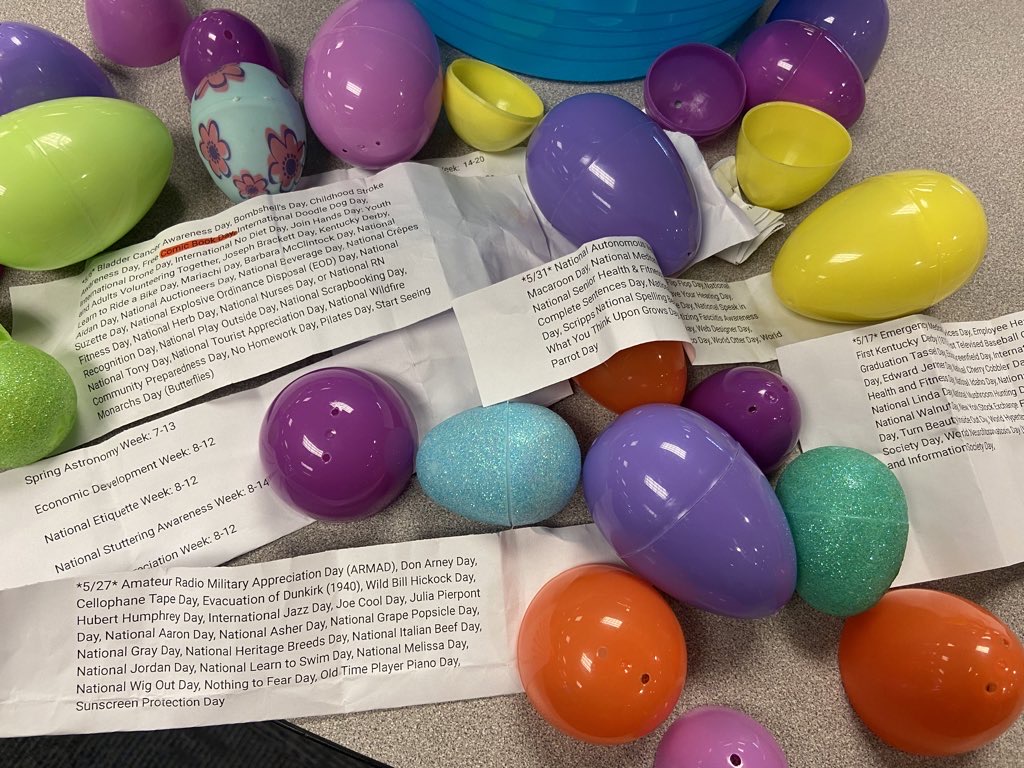
  • Share with students special days, holidays, or hide them in plastic eggs around the room. (I got the list from LM_NET and had to cut some out due to the age of my students.) Students select one to learn more about and then share with their classmates what they learned. You can have them write it on a sticky note, make a poster, or a digital copy.
This poster displayed here is from my Capstone Publisher representative:


  • Survey students about their opinions about the library program or your classroom.  I've had students use devices to fill out Google Forms and I've had them write their ideas on paper posted around the room.  This helps to shape the next year and gives students a voice:


Play unplugged games

  • Peep Knock-out: you take turns with a partner trying to knock a Peep off of the side of a table using only a plastic egg that you roll.  I heard about this game from a librarian colleague of mine and was waiting to play it on a special occasion. My 1st graders played the game and then we came together to critique it and adjust the rules for playing it again in the future. 


  • "Water Balloon Battle" or "________ Battle": You take turns launching a balloon on paper towards your opponents figures, also drawn on paper.  Your eyes are closed when launching and if you hit the figure then you succeed.  I first saw this on a fellow librarian's Twitter account and had my students play it, they loved it!  They also had fantastic ideas for adjustments.  
    • Follow the directions below for the rules to the tabletop game: 
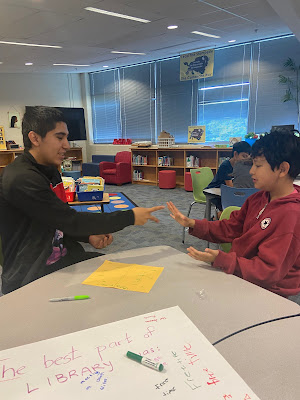
Of course there are so many fun ways to end the school year or engage with learners to build community, please leave your favorite activities in the comments or if you have specific questions, send them my way.


Tuesday, January 10, 2023

Poetry: the art of language


April is National Poetry Month, but the art of language is to be celebrated all year long.  When my students first hear that we are going to study poetry, many groan, unsure of what is to follow.  Thankfully, after these engaging and creative ideas, they change their perspective to one that celebrates the various forms and topics that one can express through the art of language.  

Shape or Concrete Poems:  a poem that takes the shape of its subject matter.  Some books that help illustrate this are:


First, we read several concrete poems and students form the definition for a concrete poem.  Then I take them through a group writing experience where we brainstorm a list of items they generate. Then we take one and I loosely sketch an image that is associated with that. Then we come up with descriptive words, feelings, similes, metaphors, and analogies to write our ideas in the borders of the shape.  Students who are able can try this out on their own, or for those who need scaffolds you can provide the outline of various shapes along with vocabulary for students to cut out and glue to form their concrete poem.  

Blackout Poetry:  this is when writing that has already been published is used as inspiration for carving out a poem from those words already printed.  The poet can circle those words they wish to use and black out the rest of the words through patterns, other colors, or by blacking them out.

Rather than use books for this I like to use images from Google to show examples of blackout poetry and ask students to tell me what they notice about the poems.  

Note: I used to use newspapers for this, however, I had to be careful about the subject matter, vocabulary and layout of the articles in comparison to the advertisements, so ever since those experiences I have turned to using pages of discarded or weeded books to give to students for this type of writing.

Homophones, homonyms, idioms, puns:  poetry doesn't have to be lyrical or rhyme. Poetry can be the juxtaposition of words with multiple meanings and clever sayings explained in literal terms.  My students enjoy exploring this aspect of language because it is in small bites rather than long poems to analyze or just rhyming poems meant to  entertain.  Some books that we study during this topic are:


A video that my students like to watch and sing along with is below:

Poetry Slam:  lyrics of songs and poems are meant to be heard aloud, therefore, I invite students to read or recite poetry or songs aloud in front of an audience or if they'd rather, record and edit a video of their poem or song on a video production application, like Apple CLIPS or iMovie.  Students should be given time to find a poem or song with which they connect and choose to share it with others. For the Poetry Slam experience, I hang twinkle lights up, spread out picnic blankets and a variety of flexible seating options around as the lights dim and we can enjoy one another's love of language.  

Book Spine Poetry: this is one of my favorite types of poetry to share with students. First we look at a variety of examples and students form a definition for what is included in a book spine poem.  Then students are sent in partners or small groups to a certain part of the library to create their own book spine poem.  I ask students to take a photo of their poem on their device so that I may project it for the class, but they also like to display their book spine poems for others to read.  The best part of this experience is that students always find books that they want to read that they may have never even chosen if not for this opportunity to look for interesting book titles. 


An extension of this is to add music or other effects to the mood of their poems using a collage of photos or a technology application, like iMovie, FlipGrid, Seesaw, or Apple CLIPS.

Although some librarians hesitate to use book spine poetry with students due to the large amount of shelving that will follow the experience, Mike Rawls, a.k.a. The Book Wrangler, suggests using paper spines with book titles already on them or you can photocopy.  

Novels-in-Verse: a story written in verse is one of my favorite formats to share with students. Much like a chapter book or graphic novel or picture book format, a novel-in-verse is another way that writers tell a story, but in lyrical form.  

Do you have a favorite way to share poetry? Please leave a comment below!


Sunday, February 13, 2022

106 Kindness Books & Activities for Elementary & Middle Grades


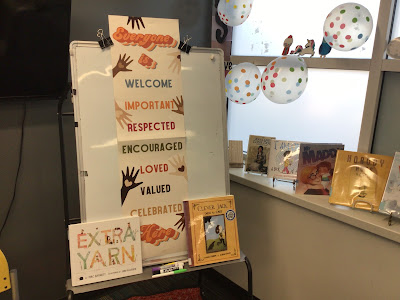
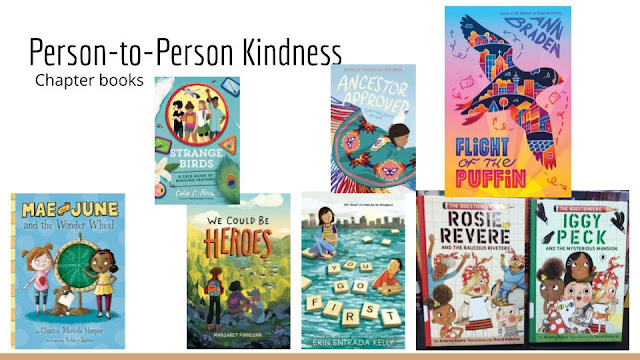
The month of February is dedicated to friendship, kindness, empathy and love.  When I was curating the book display for my students across grades kindergarten through fifth grade, I began seeing common themes arise:  how kindness is shown between people, towards animals, between animals, with grandparents, and towards oneself.  


During my library lessons I book-talked these books with the themes and my students responded with interest and enthusiasm.  They began recalling other stories that fit in the themes that I hadn't added so they recommended them to their classmates.  Every class that came through the library selected books from the kindness display and discussed their choices with their classmates.  This led me to share my list below along with extension ideas:


Extension ideas that go with these books and themes are numerous:

  1. Give students the themes, then book-talk a book or show the cover and have them guess what theme it would be.
  2. Ask students to write or draw a story from their life that exhibited kindness.  Have them share with and ask others to determine the theme.
  3. After choosing a book, ask students to create an artifact, button design or keychain charm that pairs well with the theme of the book.
  4. Allow students to use a video creation application to tell which book they recommend to others. You can show them vintage Reading Rainbow clips as inspiration. 

  5. Give students a random picture, ask them to think of a story that incorporates the picture with a kindness theme. If they are stuck give them the prompt, "Once upon a time in ________ (setting) there was a __________(character) who wanted to _____________ but couldn't (plot). Then _______(climax) came along and ___________(resolution).  Let them pair up and combine their picture prompts and story ideas. They can even share them with others or act them out.


Do you have more books and/or activities to suggest that go well with these themes? Please share them in the comments below!

Nest of Tongues: Filipino Vampire Folkore

Randy Ribay' s young adult novel, Nest of Tongues , is a suspenseful, unique story of teenage Filipino siblings in the Bay area who happ...