Search This Blog

Showing posts with label education. Show all posts

Tuesday, May 30, 2023

Creative ways to end the school year


The end of the school year marks a unique opportunity for educators to create lasting memories with students. If you aren't able to try any of these activities out this year, keep them in mind as beginning of the school year rolls around or use them at the close of next year.

STEAM challenges

  • Students choose a book, either a new one or a past read that they enjoyed.
          They must create an object that goes with the book. Then they share the story and what they chose to create with their classmates. These can go on display or be taken home, depending on the materials used with the books. 

Pictured here are my students using LEGO blocks:


Students were challenged to build a troll bridge out of LEGO blocks. I gave them a piece of blue paper as the water and the only stipulation I made was that it had to be elevated, not touching the water.  As the students worked they found that they wanted to continue the challenge with more requirements, like the ones that are the sturdiest, tallest, etc. 

The best part was listening to them share their strategies for building and helping each other when they got stuck. It also inspired some to want to perform a reader's theater of the story! 


  • Put up a big Spot the Difference to complete as a class. Then challenge students to make their own and trade with one another. They can use old magazines to cut out pictures and words or use Google Slides or another digital format to make their pictures. 
The one shown in this video is from the publisher's website for the book, Someone Builds the Dream by Lisa Wheeler and Loren Long. 


  • Challenge students to create a BookFace photo. They will need access to a camera and book covers You can do this with book covers that are already separated from books or from the books themselves. In small groups, 3 people is usually good, students select a book cover that they can finish with their own bodies, faces, or other objects. Then students pose in a way that aligns with the book's cover art and another student takes the picture. Pictures can be edited and cropped so that only the BookFace remains.  Here are some of our favorites from this past year:


Blast From the Past

This is a fun way to look back on the school year and reflect on those moments of growth, humor, and classmates who have come and gone.  

  • Show photos and ask students to recall those lessons. I also record or have them write down what they are interested in at the start of the school year.  At the end, I share with them what they said and ask if anything has changed since then.  It is so neat to hear how their interests and lives change.

  • Roll videos produced by students, for example, stop motion films, book trailers, etc.  After looking at some, students asked to make more next year and for specific events, like, Talk Like a Pirate Day.  We even made several of our own as a class on our last library day!


  • Have students rank their top reads of the year. Our library management system allows them to see their circulation history, so students were able to rank their favorite books they checked out. 


Looking ahead
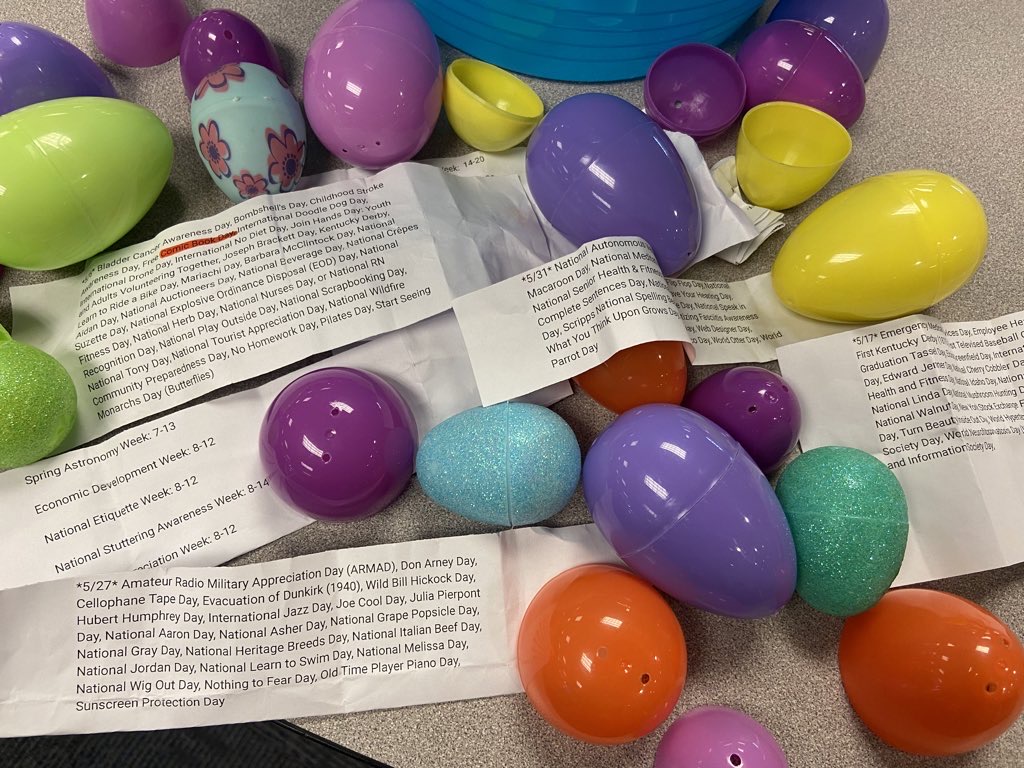
  • Share with students special days, holidays, or hide them in plastic eggs around the room. (I got the list from LM_NET and had to cut some out due to the age of my students.) Students select one to learn more about and then share with their classmates what they learned. You can have them write it on a sticky note, make a poster, or a digital copy.
This poster displayed here is from my Capstone Publisher representative:


  • Survey students about their opinions about the library program or your classroom.  I've had students use devices to fill out Google Forms and I've had them write their ideas on paper posted around the room.  This helps to shape the next year and gives students a voice:


Play unplugged games

  • Peep Knock-out: you take turns with a partner trying to knock a Peep off of the side of a table using only a plastic egg that you roll.  I heard about this game from a librarian colleague of mine and was waiting to play it on a special occasion. My 1st graders played the game and then we came together to critique it and adjust the rules for playing it again in the future. 


  • "Water Balloon Battle" or "________ Battle": You take turns launching a balloon on paper towards your opponents figures, also drawn on paper.  Your eyes are closed when launching and if you hit the figure then you succeed.  I first saw this on a fellow librarian's Twitter account and had my students play it, they loved it!  They also had fantastic ideas for adjustments.  
    • Follow the directions below for the rules to the tabletop game: 
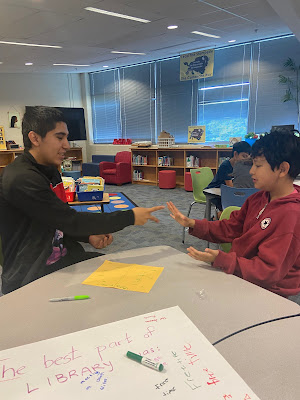
Of course there are so many fun ways to end the school year or engage with learners to build community, please leave your favorite activities in the comments or if you have specific questions, send them my way.


Sunday, May 2, 2021

Know your worth: Brother's Keeper


Brother's Keeper is a middle-grade, award-winning, historical fiction debut novel by #ownvoices author, Julie Lee.  It is partially based on the experiences her mother had while growing up in North Korea in the 1940s and escaping the harrows of war by journeying to South Korea for a better life in 1950.  This is a tale of survival and family, but also it's an emotional perspective on negative gender stereotyping and what it was like for North Koreans living under Communist rule.  There are lots of topics for further study and discussion questions that readers can use for book clubs.

12-year-old Sora lives in a North Korean village with her parents and two younger brothers.  She was just told by her mother that she would have to stop attending school in order to stay home and take care of her brothers while her parents work in the fields.  She knows that this is a cultural expectation, however, that doesn't stop her from wanting to pursue her studies, especially, writing.  It also doesn't make her feel better when her parents and neighbors constantly praise her brothers only for their gender.  This pressure for her to learn proper cooking in order to marry well in a few years causes great anxiety in Sora and a rift forms between her and her parents.  

Life under Communist rule adds strain to their daily lives.  As the war gets closer to their village, Sora has flashbacks of when a family member was arrested and imprisoned for helping people cross the border into South Korea.  The risk of her father being forced to join the Communist army is so high that they even bury him in a hole in the ground for months so he stays safe!  Only when the bombs start dropping on their village is it the sign they need to flee.  Sadly, Sora and her 8-year-old brother, Youngsoo, get separated from their family and it is up to Sora to keep them alive and make the difficult decision to continue trekking south toward freedom. As Sora dreadfully thinks when Youngsoo asks her how they will cross the river without a bridge, "I didn't know, and I didn't trust myself.  Yet every decision was up to me--our lives depended on it."

Since the book opens up with a map of Korea and their journey on foot and train is marked, the reader knows that they both do make it to their final destination even before reading a single word of the book.  That is a relief, except the reader knows that this is only Sora and Youngsoo's journey and that it doesn't include their family members who the readers get to know so well throughout the story.  


Lee also divides the book into 3 parts: Home, Escape, and Busan.  This helps the reader get ready for what is to come in the most basic sense.  Lee describes their tribulations with such brutal detail that it was hard to continue reading at times.  War is difficult for everyone and Lee brings that gruesome truth to light when documenting Sora and Youngsoo's journey.  In one way, their escape contains all of the parts of a survival tale: cold, fatigue, hunger, lice, attempted kidnapping, even being driven to theft of food and begging for money for medical attention for Youngsoo.  In another way, after they reach their destination, it is a whole other type of survival for Sora.  She must go back into the gender expectations by learning how to cook, clean and take care of a house so she can be a good wife soon.  

As a teacher and librarian, I would use this book to discuss a range of topics.  First, readers can consider how the talk of gender affects children.  In one scene, Youngsoo confides in Sora of his discomfort with being the first-born son.  He says it is too much pressure for him.  This surprises Sora.   What do readers think about this revelation?  Should Youngsoo speak up when his parents and neighbors put-down Sora and insult her because she is only a girl?  How do we see these gender stereotypes reinforced in American culture?  In another scene, a young woman encourages Sora to make sure that she looks after herself first, then her brother. "Know your worth."  This advice brings tears to Sora's eyes because she had always been told to be the martyr and do everything, at whatever cost, to keep her brothers alive and well.  What do readers think about this advice?  Why do we need others to give us pep-talks like these?  Who is someone that readers have in their lives whom they can give this type of advice?

The book ends with several sections that lead to further study and discussion for readers.  First, there is an Author's Note where Lee describes all of the fiction and non-fiction parts of the story. Here is a video of Lee explaining her family's connection to the book:


There is also a section for photos from Lee's family during this time period.


Another section is a glossary of Korean words and finally, a timeline of the Korean War. 


Readers can dive into these and the story is instantly enriched. TeachingBooks.net has a free discussion guide to use, too.  I had never read a book from the Korean perspective during the 1950s and it has made me curious about other people's experiences during this time period .  As Lee writes in her Author's Note, "the stories of refugee survivors remain largely untold..."  

Dasia (Forever)-a middle grade novel tackling serious topics

  Dasia (Forever) by Nic Stone , a middle grade novel sprinkled with letters in a verse format, provides a raw, emotional perspective of Da...