Search This Blog

Showing posts with label American History. Show all posts

Friday, February 18, 2022

From a Whisper to a Rallying Cry: Asian-American activism begins


From a Whisper to a Rallying Cry: The Killing of Vincent Chin and the Trial that Galvanized the Asian American Movement by Paula Yoo is an award-winning non-fiction, young adult book that looks deeply at the people and circumstances that launched activism for Asian-Americans.  Yoo uses primary sources and interviews from the 1980s to the present-day hate crimes against Asian-Americans due to the Coronavirus pandemic to put the whole plight of Asian-Americans in context.  This is a valuable book for U.S. History classes, social justice and law classes, as well as for teens and adults who want to learn more about other civil rights movements aside from the ones for Black people and perhaps the LGBTQIA+ communities. 

Detroit in 1982 was full of tension.  Tension between Asian-Americans and those in the automobile industry.  When a Chinese-American man, Vincent Chin, was brutally killed by two white men and the sentence was only probation and a $3000 fine, the Asian-American community organized to protest against this injustice.  Chin's wrongful death was the first case brought against someone's civil rights being violated.  The prosecutors retried the defendants claiming that their crime was racially motivated and that violated Chin's civil rights that were protected under the law.  What ensued was a years-long battle in and out of the courts with multiple law enforcement, attorneys, witnesses, and national figures for justice being pulled back in to find closure on the case.  

What stood out to me was how ordinary, everyday people got involved in the movement. For example, Mable Lim, an elderly woman who drove around Detroit with press releases shared that when she was younger she never stood up to the racism she encountered. "I accepted it, you're used to being excluded and treated differently."  Many readers may relate to Lim and her perspective, even to this day.  Marginalized groups benefit from learning about the past where coming together for a common cause brings strength to the community as a whole.

Another part of this story that was especially informative was how all-encompassing the movement became.  At first it was Chinese-American activists that then grew to Japanese-Americans, then the NAACP and Pacific Islander groups joined.  During a march an elderly Filipino man was asked why he joined and his reply encapsulated the feeling for justice, "If we don't stand together, we'll always be divided."  This book teaches the origins of the term Asian American and Pacific Islander.  Readers can better understand how these modern-day terms came about and how they are used today.

Finally, the true-crime aspect of the story is also a reason why I recommend it to young adults and adult readers.  Yoo writes in a narrative style similar to true crime podcast scripts that provide details to the reader about the background of each person involved in the case.  The courtroom scenes and judicial procedures are also notable because they were the cause of laws actually changing to ensure equitable sentencing procedures for future cases.  Readers are also not lectured at in this book. For example, Yoo doesn't state her opinions about the motivation behind the killing.  She lays out the evidence from both sides and that is what is also good to read.  How she handles the effects on the defendants' lives brought a more balanced approach to this story.

After reading this book readers will undoubtedly want to do their own research on the case and the people involved.  Yoo provides numerous sources for further reading, including the film, Who Killed Vincent Chin? Here is an interview from the Glendale Library that was done with Yoo:


Monday, February 14, 2022

Me (Moth): a journey of grounding effervescence

 Me (Moth) a young adult debut by Amber McBride is a haunting story told in verse about two teens, Moth and Sina.  Moth loses her entire family in a car accident that spares only her and she lives with survivor's guilt.  Although what she does is not considered living.  Moth cocoons herself against any enjoyment, even in her aunt's home. Her grief drives Aunt Jack to abandon her. The only voice that Moth clings to is the advice her Gray-Bearded Grandfather gave her about their Hoodoo spiritual roots.  She is surprised to be drawn to the new student, Sina, a member of the Navajo Nation, who has his own emotional struggles.  Although Moth is determined to stay invisible, Sina sees her and invites her to join him on a road trip back to New Mexico.

On this journey, Moth and Sina stop at various landmarks from Virginia to the Four Corners. As a former social studies teacher and librarian, it stood out to me how these characters take in each place through their own unique lens.  For example, while in Monticello, Thomas Jefferson's home, they visit the quarters for the enslaved people and leave offerings for their courageous legacies.  It's refreshing to have a point of view that is seeped in spirituality and a recognition for marginalized groups.


I highly recommend this book for young adult readers and adult readers because of the topics of identity, supporting one another and for learning about non-Western beliefs.  The characters show strength through their struggles in a mystical, dreamy way.  McBride writes as if the reader is floating above the story, yet feeling as if their feet are planted firmly in the Earth.  I don't want to spoil the story but it ended in a way that made me go back and reread it knowing how it ended; it was like an entirely different story!  Only a master storyteller can accomplish something that beautiful.


Congratulations to McBride for being a finalist for the National Book Award 2021 in the Literature for Youth category. Here is McBride reading an excerpt from Me (Moth): 


Sunday, January 23, 2022

Revolution in Our Time: the Black Panthers' rise, fall & legacy today


Kekla Magoon's young adult, nonfiction book, Revolution in Our Time, about the history of the Black Panthers, their enduring struggle for progress in their lifetimes and the recurring themes in the modern-day American society is a poignant informational book that benefits everyone who reads it.  

The Black Panther Party played a large role in pushing back against racist policies in communities, however, the media portrayal focused on the sensational aspects rather than the multi-faceted parts of the movement that actually helped communities.  This is where Magoon's book comes in to set the record straight on how women and children were the focus in order to provide for their basic needs while in poverty.  

The book starts out when in 1967 a group of Black Panthers walked onto the floor of the California State Legislature to express their position on Black people being able to defend themselves against unlawful attacks.  How did this group form and come to this pivotable moment when they were splashed in headlines all around the country?  Magoon then takes the reader back to 1619 until 1965 and summarizes how Black people have endured inhumane treatment up until 1965.  She explains the group's formation in 1966 during the Civil Rights Movement and how they grew in numbers all while being targeted by law enforcement and the FBI.  Magoon finishes the book by going full circle to when the group disbanded in 1982 until the present day struggles for the same protection under the law that was the cornerstone of their platform from their formation. 

It reminded me a lot of Stamped: Racism, Antiracism and You and You Call This Democracy?, both written with a young adult audience in mind.  Our youth deserve to know the historical events that have led our country to the state it is in and how they can help improve their world by not repeating mistakes of the past and recognizing what has worked before.  This is an excellent book for teens and adults to read together and use it study the figures and events on their own.  Full of photographs, quotes, and a storytelling technique that will leave a lasting impression in the mind and heart of the reader, this should be shared and discussed by all who care about Black people.


Click HERE for my book review of this book.

HERE is a short video of Kekla Magoon discussing her book.

If you have middle grade readers (ages 8 - 14) who'd like to learn more about The Black Panthers I'd recommend Rita Garcia-Williams' award winning trilogy:


Sunday, November 28, 2021

Last Night at the Telegraph Club: a Young Adult historical fiction coming of age tale


Last Night at the Telegraph Club the 2021 National Book Award for Young People's Literature written by Malinda Lo is a story that has yet to be told in the arena of young adult literature. Lo deserves the award for her portrayal of Lily Hu, a 17 year-old Chinese-American daughter of immigrants who settled in Chinatown in San Francisco.  The year is 1954 and the Red Scare is is buzzing all around Lily and her community. She must be careful with whom she associates or else it could spell trouble for her family.  What ends up happening not only affects Lily's future, but also those around her.  

With the tone of a coming of age story, Lo reminds the reader of what it's like to be a teenager trying to figure out who you really are.  When Lily sees an advertisement for The Telegraph Club with a male impersonator or cross-dresser, something in her is awakened. She feels drawn to the club and finds a fellow classmate, Kath, who has an in there.  Once Kath introduces Lily to the club and the people inside, a whole new world opens up for Lily.  A world where others who feel like her can feel normal.  How can Lily return to the person her family expects her to be after she's discovered her feelings for women?  

The best part of this story is when Lo uses the flashbacks between Lily's storyline with ones about her parents and her aunt.  Their own circumstances and journeys to the U.S. to where they are in the 1950s sheds much light on their actions.  As I read the story I kept telling myself if Lily only knew her own family's struggles with their identity in the U.S., then she could open up to them about her own apprehension about where she stands.  

As a former history teacher, I also enjoyed the timelines that Lo includes that show the year, Lily and her family's major moments, and parts of world and American history that have affected Chinese Americans since they were first brought to the U.S. to build the trans-continental railroad.  As the daughter of an aerospace engineer, I enjoyed the development of the Jet Propulsion Laboratory as Lily's other passion is studying space travel.  Thankfully her aunt is a human computer for the program and encourages Lily to pursue her interest in math, science, and engineering.  This part of history is interesting for readers to compare to Katherine Johnson and her pioneering work she did for NASA.

This story is an important one for people to read who may not be familiar with the experiences of Chinese Americans.  It's also a history of how the LGBTQ+ community has had to seek out safe spaces to be themselves.  It surprised me that in the ever-inclusive city of San Francisco, there was once a time that it was illegal for homosexuals to even congregate in public.  The end of the novel is full of more information that Lo explains served as her basis for all of the storylines in the book.  Readers who are interested have a number of resources to use to continue learning about more people who lived during this time and left their mark on the country. 

Monday, November 22, 2021

I Can Make This Promise: family secrets & identity


 Christine Day's debut middle grade novel, I Can Make This Promise, conveys a perspective of a 12-year old Native American girl who only knows that her mother was adopted by a White couple so she has no connection to the Native side of her heritage.  Although Edie is constantly "othered" by people asking her "what are you?", she feels as though her parents would've shared anything they knew with her.  That is until she and her friends stumble across a box of keepsakes in Edie's attic full of mysterious photos, letters, and postcards.  The woman in the photos looks just like Edie and even shares her name.  When Edie asks her parents, they act shifty and change the subject.  Why would they keep something like that a secret? 

Edie and her friends approach this sensitive mystery in different ways. One of her friends urges Edie to talk about it with her parents more while her other friend thinks they should dig for more clues on their own.  The journey that Edie takes to find out the truth is both heart-breaking, yet, hopeful.  Day puts real faces and emotions to the atrocities Native people suffered at the hands of the U.S. Government.  Readers can take the snippets of people mentioned in the story and conduct further research about who they were and why they were considered activists of their time.  Readers can also relate to the changing friendships and history that follow them into adolescence.  Edie decides to cut ties with someone who refuses to be an ally to her and that is a situation that readers can discuss.  

As a teacher, librarian and parent, I would definitely share this book with my students and daughter.  The themes of identity, family, friendship, and historical power and injustice offer a lot of important conversations that connect to other media.  Share the book trailer below with readers to gauge their interest in this story:


Initially I read Day's second novel, The Sea in Winter and was impressed by the authentic voice her characters use while teaching the reader about the upper northwestern U.S. and the Native tribes located there.  I'm looking forward to reading more by Day!


Thursday, October 14, 2021

Loretta Little Looks Back: Three Voices Go Tell It


Loretta Little Looks Back: Three Voices Go Tell It by Andrea Davis Pinkney and Brian Pinkney is like no other book I've ever read.  The multi-generational, historical fiction novel begins during an unfair sharecropping agreement between the main character's family and a plantation owner in Mississippi. Then it shifts to surviving under Jim Crow Laws to eventually marching for civil rights.  It's a dramatic series of monologues that follows Loretta Little (from 1927-1930), Roly (from 1942-1950), and finally, Aggie B. (from 1962-1968). Each chapter has a where and when to set the stage for the reader as they step into the heart and mind of the characters.  The first-person narration told in verse, song, and illustrations transport the reader to the emotion of each character.

What stood out was how the author, Pinkney, incorporated real-life historical figures into her storytelling.  Readers can learn more about Fannie Lou Hamer, President Lyndon B. Johnson, James Forman, Emmett Till, Charles McLaurin, and of course, Martin Luther King, Jr. Pinkney also includes more information about sharecroppers in the southern U.S. with additional photos from that time.  

As a parent, teacher and librarian, I would share this book with 3rd graders and above.  It's certainly age-appropriate for readers to learn about the southern Black experience in the U.S.  Each character is strong, distinct and unforgettable.  The illustrations help readers understand the essence of the story without giving away too much.  

Here are several video interviews the Pinkneys did to share with readers:


Sunday, September 12, 2021

Angel of Greewood: romance set in a tragedy


Angel of Greenwood is a historical fiction young adult chapter book written by Randi Pink.  Set 11 days before the Tulsa Race Massacre of 1921, the story alternates point of view between teenagers, Angel and Isaiah.  On the surface, they couldn't be more different: Angel is there to serve others, she's interested in studying and is always home tending to her ailing father.  Isaiah on the other hand is always out of his house he shares with his mother.  He has many hook-ups and runs around town with the community bully, Muggy.  After Isaiah notices Angel dancing at church, he cannot get her out of his mind.  He invokes the help of their teacher to give them a summer project delivering books to the community so they can have a chance at a relationship.

On the surface this is a romance of two interesting characters, however there is so much more to this story than that.  Pink brings alive the community of Greenwood in detail so that by the end of the story, the characters who remain and are affected by the massacre feel real.  The tension in the story lies in the fact that the attack is coming and each chapter reminds the reader through a countdown.  Another tension is the way Isiah and Muggy's relationship changes.  Readers can relate to when a friend's actions caused anxiety and when one needs to decide to cut ties with them.  The will-they-won't-they romance between Angel and Isaiah is a beautiful unfolding.  Although they debate about the merits of writers, Booker T. Washington and W.E.B. Du Bois, they truly listen to one another and come around to understanding the other person.  

I highly recommend this book to 8th graders on up to adults.  The subject of the community in Tulsa is not taught very much in schools so this is an accurate feel for what it was like there, how the residents created this free space to thrive, and how they protected their own interests.  For further reading, Pink includes her sources and notes about the attack.  I am grateful that she set her romance story in this setting because it shows that even in the worst tragedies, the universal theme of love still resonates. 


Saturday, September 11, 2021

Remembering 9/11 through stories

 On this anniversary of 9/11, I find myself talking with young people about what they know about that day.  Some know a lot of facts based on what they have learned from their families and teachers.  This is when historical fiction novels and picture books about the event can help everyone learn more about the people who were affected by the events of that day.  Below I highlight my top picks for books for elementary and middle school readers who want to put people's stories with the facts of that day and beyond:


All We Have Left is a middle grade chapter book by Wendy Mills.  It's a realistic fiction mystery that  quickly flashes back and forth between present-day and September 11, 2001.  The flashbacks and fast-forwarded stories seem to be about two teenagers whose stories are disconnected: 16 year-old Jesse is going through a tough time as she grieves the loss of her brother on 9/11.  The question is, why was he there in the first place?  Back in the towers on that fateful day, we meet Alia, a girl who just decided to start wearing her hijab in public that day.  What brings these two together is a sad yet, hopeful tale of tragedy, loss, grief, friendship, family  and prejudice.

Mills' novel has been nominated for multiple awards and she even includes discussion questions for readers on her website.


Code of Honor is a middle grade chapter book written by Alan Gratz.  It's a suspenseful realistic fiction story about high school senior Kamran Smith.  He's enjoying his last year of school as he prepares to follow in his older brother, Darius', footsteps and attend West Point.  One night the TV news reports that his brother has now joined Al-Queda and is now a terrorist targeting the U.S.  Kamran doesn't believe it, even after watching his brother's video rampages about fighting off the evil in the world using games they made up as children.  Kamran and his parents are taken into custody for questioning and only one CIA officer believes Kamran's theories that his brother is innocent.  They work together to crack the code of messages Darius tries to send to his brother, but with an attack on the horizon, they'll need to work fast and in secret to get to the truth.

Gratz's novel was nominated for multiple awards and the audiobook version is quite compelling. Gratz has an excerpt on his website to read and share with potential readers.  He also has a new book out specifically about the events of 9/11:


Nine, ten: a September 11 Story is a middle grades chapter book written by Nora Raleigh Baskin.    This is a realistic fiction novel about four middle schoolers who the reader learns about a few days before the 9/11 attacks.  It seems like their lives cannot intersect at all, but in a twist of fate their paths do cross in surprising ways.  Baskin's novel was nominated for multiple awards.  

Here is a trailer for the book to share with readers:


14 Cows for America is a nonfiction picture book written by Carmen Agra Deedy, Wilson Kimeli Naiyomah and beautifully illustrated by Thomas Gonzalez.  This is a true story about what happened when people around the world heard about the 9/11 attacks, specifically, what a group of Masai warriors did in Kenya to help show their support for the people of the U.S.  There is a whole website dedicated to this book for reader to find out more about this event.  

Here is Deedy talking about how she came to writing about this true story:


Fireboat is a nonfiction picture book written and illustrated by Maira Kalman.  It tells the true story of a boat created by John J. Harvey in 1931.  For many years it was kept in the Hudson River as a relic of the past but it was called up on on the day of the 9/11 attacks to help firefighters fight off the fires from the attack for 4 days and 4 nights.  This is a great book to share with young people to focus on the first responders who did their best to save lives after the attacks.  Kalman's website has excerpts from the book to view with readers.


Saturday, August 28, 2021

Hearts Unbroken: a young adult #CreekVoices tale of love and hate


Hearts Unbroken is a young adult chapter book written by New York Times best-selling author and former KU Jayhawk, Cynthia Leitich Smith.  Universal themes of caring about others resonates through each page.  

Lou's entering her senior year at a Kansas City high school and she's just broken up with her popular, jock boyfriend who made fun of her Creek heritage.  Lou's dedicating her time to focusing on school and her family, especially since her younger brother, Hughie, is a freshman and he makes it into the musical production of the Wizard of Oz to the dismay of many in the community who want to see white students cast in the big roles.  The town becomes divided on if it makes a difference as to who plays the characters and if those casting decisions affect the purity of Baum's story.  Hughie even gets threats in the mail that scare Lou.  Although Lou was definitely not on the lookout for romance, she is swept up in the arrival of Joey, the new Lebanese-American student who is working with her on the school newspaper.  Will she be able to follow her heart and make better choices that will strengthen her identity?

What stood out to me about this story was the network of community support that Lou has throughout her ups and downs.  Lou asks her father, how do you tell someone you care about them with the fear of rejection at hand?  He says,

"What I wouldn't give for this to be the worst problem you'll ever have.  But, pumpkin, caring about somebody isn't trivial.  It can keep you going."  

Readers can discuss times that they've had people express their care towards them and who they care about the most in the world.  

Another part of the story that I appreciated was the role of the librarian in the story!  It showed how librarians are trained to connect the right person with the right book.  For example, the librarian buys a book for Hughie, If I Ever Get Out of Here by Eric Gansworth of the Onondaga Nation.  Readers can ask their librarians for topics that interest them and have a conversation about books and authors that they may try out.  


The overarching theme is how racism seeps into the daily lives of minorities.  Lou talks with her classmates whose parents are leading the charge against people of color holding main character roles in the musical and the classmates confess that they hear racist conversations in their households.  They thought that Lou would assume that they shared these racist ideas as their families did, but Lou tells her friend, "You're not your parents."  This is a powerful moment where readers can decide what to do and say when they realize that their families have racist or prejudiced opinions about others.

Readers can find real life examples of when traditional White roles have been cast to people of color.  In the story, the role of Dorothy goes to Chelsea, a Black student who is a talented performer.  This is similar to when the live action movie of The Little Mermaid cast Halle Bailey in the role of Ariel and there was pushback from some Disney "purists" who believed this was not a good choice. Readers can share their opinions about where they stand on this issue.


Smith also touches on the racist background of the Wizard of Oz writer, Frank Baum.  Hughie discovers this while researching his role and finds editorials from a South Dakota newspaper that Baum wrote advocating for the genocide of Native Americans.  What's impressive is that Smith doesn't just write about them in passing, but has the actual primary sources from the newspaper printed in the chapter.  Readers can discuss what options people have when learning about the true nature of creators from the past.  I don't want to spoil the story so I won't mention what Hughie does here, but readers can share if they agree with Hughie's decision or not.

Lou also faces conversations about race and prejudice with Joey since he is Lebanese.  Readers can think about the stereotypes associated with people from the Middle East and how they can go about talking about those with others.  I'm impressed by Smith as she weaves all of these important topics into an entertaining, heartwarming story about a Creek young woman coming into her own. Lou's not perfect and that is something to which everyone can relate!

Smith's website has a treasure trove of resources for book clubs and more. I hope young adults and adults read and discuss this award-winning book.


Friday, August 6, 2021

The Revolution of Evelyn Serrano: a Puerto Rican voices & activism tale


The Revolution of Evelyn Serrano by Sonia Manzano is a middle grades, historical fiction novel set in Harlem, New York in 1969.  It's a Pura Belpre Award Honor Book and it was awarded to Manzano, "a Latina author whose work best portrays the Latino cultural experience in a work of literature for children or youth."  I learned a great deal about Puerto Rican history and how their experiences on the island shaped their community in Harlem. A story of truth, pride and forgiveness that will stay with readers long after they finish the last page.

Evelyn, a teenager who lives with her Mami and step-dad in El Barrio in east Harlem is figuring out who she wants to be.  Maybe going by her middle name instead of Rosa will help her stand out.  When her estranged abeula comes to stay with them Evelyn's shocked by her appearance, demeanor and attitude--she's so different than her mami!  Evelyn learns secrets about her family in Puerto Rico and starts to get involved in the Young Lords' activism to be treated better in their community.  Evelyn says, "...I did get this: that it wasn't just us Puerto Ricans who lived in a culture that didn't like us and that other people in the world lived in the same situation."


I loved the character of Maria on Sesame Street so when I learned that the actress who plays her, Sonia Manzano, wrote this novel, I knew I had to read it.  What stood out to me was Puerto Rico's history, like the nationalists who wanted the island to be apart from the U.S., how during the Great Depression it was even worse for people on the island, and how people in the U.S. who were born here but are Puerto Rican are called, "Nuyorican." Adults will enjoy the book with famous cameos by other well-known Americans and the musical references to Pepe y Flora may get their music playing while reading this story:


Manzano includes resources more details about this time in history in her Author's Note and explains that the Spanish words and Spanglish that are used in the book are regional phrases and what her family used to say.  For readers who want to learn more about this time in history, a list of resources for further reading is provided.  There is also an Educator's Guide for teaching this book with students and it gives more background on Manzano and what brought her to write this novel.  


Monday, June 28, 2021

Cuba in My Pocket: a refugee's tale of uncertainty & hope


Cuba in My Pocket, the middle grades historical fiction chapter book by award-winning author, Adrianna Cuevas, tells the story of 12 year old Cumba who, in 1961, is forced to flee Santa Clara for the U.S. in order to avoid being drafted into the military for Fidel Castro.  Based on the author's family history, the book is full of intimate details that can only be from the perspective of someone who lived it.  The story is one that should be shared with middle grade readers on up because it tells the important part of history, how governments impact people's lives, and the real accounts of people who risked it all in order to have a chance at a future for themselves and their families.  

Cumba's relationships with his family and friends in Cuba are the most memorable parts of the story.  They play dominoes, cook delicious meals, go looking for flowers and even discuss how their lives have changed after Fidel came to power.  Readers can continue with learning about these parts of Cuban history and culture by looking at photos and videos of Cuba prior to the 1960s and afterwards.  Cumba relies on the strength of these relationships to propel him towards the unknown in the U.S. and holds on to the promise of reuniting with them again.  

Cumba's journey to the U.S. is another important part of the story that readers will never forget. From his flight to Miami with another young girl traveling alone who doesn't understand the language or even how to put on a seat belt, they rely on the kindness of other passengers to guide them through.  Cumba's school experience in Miami is like being pulled into a rip tide because of the cacophony of noise, not being able to practice his English, and his teachers not making any attempts to help him.  This is especially gripping to me as a teacher.  Thankfully he does make an American friend who makes going to school more tolerable, but the PTSD that Cumba has as a result of living in a militaristic society, is keeping him from moving on.

The reader also learns about the role the Catholic Church had in taking in young children from Cuba and sending them to foster families across the U.S.  Cumba and his house-mates use the Catholic Welfare Services to help them locate their family and friends who were supposed to be coming to the U.S.  If readers want to continue learning about this part of history there are many resources that offer more glimpses into how the church supported Cuban immigrants.

When Cumba gets sent to a foster family in Key Largo his story does change for the better.  School is a complete change as his teachers help him learn the content through visuals and study tips.  He even reunites with a friend from Santa Clara and they bond over being the only Cubans in school.  Even when he gets bad news from home and feels helpless he knows he can rely on his friend to understand exactly what he's feeling: helpless and guilty.   Here they are enjoying life in Key Largo while their families are experiencing torture in Cuba.  I think other immigrants can relate to this feeling, too.  We are grateful for being able to be here in the U.S. but also have guilt that our family members are struggling in our home countries.   

I applaud Cuevas for writing this story and honoring her family's history.  The photos and glossary at the end of the book offer more details about the Spanish language and why she chose to write her father's story.  As an adult, I learned a lot about Cuba's history and how refugees were treated during this time.  It would be a good book for grades 4 and up. Here is the author talking about the book in her own words:


Saturday, June 19, 2021

Juneteenth, a day to remember & celebrate


When I teach my students about Juneteenth, the day that the last of the enslaved people in the U.S. learned that they were free due to the Emancipation Proclamation made two years prior, June 19, 1865, they are in shock at how long it actually took for the message to be communicated.  Their questions immediately begin:
  • why weren't they told?
  • how did the message not get to them for two years?
  • did enslaved people try to escape their captors during that time?
  • what did the enslaved people do after they found out?
  • where could the enslaved people go after that?
This part of American History is an important one and the books that we currently have in our collection only touch on parts of it.  I am looking forward to adding more stories to help learn more about it.  For now these are some reads that worth reading & discussing with elementary & middle grade students:


Sugar by Jewell Parker Rhodes: historical fiction, post-Civil War
    The Civil War is over and technically, 10 year old Sugar is free but where is she to go?  She remains on the plantation where she was enslaved and is working there.  When the plantation owner brings in a large number of Chinese immigrants to work alongside Sugar and the formerly enslaved people, there is a rift between the groups.  Sugar, along with the plantation owner's son, Billy, make a friendship and try to bring the groups together.  


Stamped by Jason Reynolds & Ibram X. Kendi: nonfiction, history of racism
    Based on the adult version of Dr. Kendi's book, Stamped from the Beginning, Reynolds breaks down the start and origins of racism in teh world into language that young people can understand.  Each section is chronological and discusses how and why slavery began.  The arguments made to make people that Black people are inferior are laid out and revisited up the present.  The main definitions of segregationists (haters), assimilationists (likers) and anti-racists who want Black people to be themselves.  There is lots to discuss and extensions for research possibilities abound.  There is a new version for even younger readers out now, Stamped for Kids.


Unbound by Ann E. Burg: historical fiction, slavery, novel-in-verse
    9 year old Grace is told that she is to leave the familiarity of her mom, aunt and little brothers in order to be sent up to the "Big House" to be enslaved there.  With her near-white skin and pale blue eyes she's an "investment," according to the head of the household.  Up in the Big House, though, it's the Missus who strikes fear into Grace.  Grace decides to run away and bring her family with her.  Numerous people help them to escape but they find themselves going down dangerous paths.  Heartfelt, touching, and violent at times, this is a story based on true accounts of real people who lived these parts of history.


The Journey of Little Charlie by Christopher Paul Curtis: historical fiction, 19th century American South
    This chapter book tells the story of a 12 year old boy named Charlie whose father just passed away.  Since he was a sharecropper in South Carolina the owner of the land came to collect on a debt and Charlie had nothing to give him.  They strike a deal where Charlie accompanies the man, Cap'n Buck, up north to track down people who stole from him.  When Charlie finds out what is truly happening, he must change course without being caught.


Chains by Laurie Halse Anderson: historical fiction, revolutionary war
    The year is 1776 and an enslaved girl in Rhode Island named Isabel has just been sold to a couple who remains loyal to King George.  Thankfully her 5 year old younger sister, Ruth, is sold with her so they can stay together.  When they arrive in NYC, Isabel is exposed to harsh treatment by the couple.  When she is approached to work as a spy for the rebels she agrees with the hopes that they will reward her and Ruth by setting them free.  Intertwined with actual accounts from this time in history, Anderson tells a moving account of hope, survival and mixed loyalties.  This is part of a trilogy called, The Seeds of America. Click on the author's website link to read an excerpt, find activities, a teaching guide, and hear Anderson talk about the book.


Before She Was Harriet by Lesa Cline-Ransome and James E. Ransome: picture book biography, poem 
    This beautifully illustrated and written picture book tells the many roles that Harriet Tubman played in her life before she helped enslaved people escape their captors on the Underground Railroad. She used her skills as a nurse, aunt, spy, conductor, general to help those around her live better lives. An inspiring story about a real American hero.


Here are more book suggestions for:
These are the books we plan to add to our library collection that are specifically about Juneteenth:

Sunday, June 13, 2021

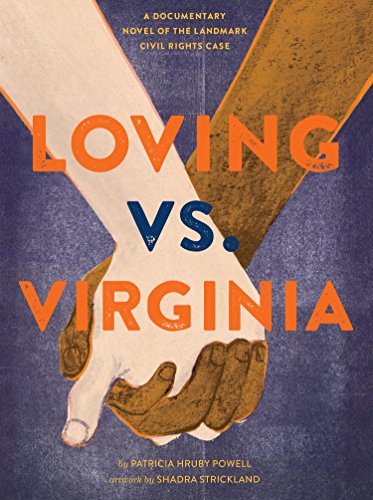
Making Interracial Marriage Legal: Loving Vs. Virginia


According to Britannica.com, Loving v. Virginia, legal case, decided on June 12, 1967, in which the U.S. Supreme Court unanimously (9–0) struck down state antimiscegenation statutes in Virginia as unconstitutional under the equal protection and due process clauses of the Fourteenth Amendment.


A middle grades, historical fiction, novel-in-verse, Loving Vs. Virginia by Patricia Hruby Powell and illustrated by Shadra Strickland,  tells the story of a civil rights topic that has everlasting effects on the U.S.  

In the 1950s a majority of the country had laws against people of different races marrying.  Through this story the reader learns of Mildred (Millie), a young Black woman who lives in Virginia with her large family out in the country.  They farm, run a business and love playing music and dancing with their friends.  Richard, a young white man, is one of those friends who grew up with Millie.  As they get older they fall in love and have two babies.  They go to Washington D.C. to get married but are arrested after they return to Virginia.


Told in alternating viewpoints, the story unfolds as Rich and Millie Loving become outspoken about their right to marry and live in Virginia with their family.  Their tale is interspersed with primary sources that take place alongside their landmark Supreme Court case.  Moving, tender, and honest, every teen should read this book to understand more about the history of race relations and civil rights in this country. 

Watch a video interview of the creators of this book HERE.

Uprising & Boys Without Names: child labor, then & now


Uprising, a middle grades historical fiction novel by Margaret Peterson Haddix, explains the role of worker's rights, suffrage, immigrants' living conditions, and activism in the early 1900s that led to the tragic Triangle Shirtwaist Factory fire in New York in 1911.  The novel alternates between three different girls' point of views and each one seems to be in their own world until their lives intersect.  The reader also knows that the tragedy of the fire will happen at some point so reading the story is extra suspenseful because there are constant dangers leading up to the fire.  Readers get to know the three girls incredibly well so by the end of the story the way they either survive or not is especially hard-hitting to the reader.


I used this novel as a whole class read with my American History classes for 7th and 8th graders and it sparked many discussions about living and working conditions for immigrants in the late 1890s and early 1900s. Haddix brings in facts about the time period and real people so students can get a sense of what actually happened.  They went on to read about and research the events and people that Haddix names in the novel.  New terms, such as "scab" and other vocabulary that we use today is shown in the book so it helps students understand those ideas in an enriched context.


After reading this novel and mind-mapping while reading it, our students got the chance to have a Skype author-visit with Haddix.  She was incredibly gracious to share with us her research process for this topic and answered all of the students' questions.  I highly recommend using this book in American History classes and engaging with Haddix before, during or after reading the novel.   

This was also a smart book to choose because we studied other labor movements, like Cesar Chavez and Dolores Huerta  , and students could better connect with those parts of American History.  Child Labor is a subject in which my students took an interest in and they explored that topic by reading the book, The Boys Without Names by Kashmira Sheth:


Sheth describes the conditions that bring together a group of boys forced to work against their will in Mumbai, India.  After reading and discussing the book, our students engaged in a discussion with Sheth through a Skype virtual-author visit.  Our students continued to learn about the plight of child labor in various places in the world, as well as in the U.S.


Both of these books offer middle grade and high school students the chance to learn more about important topics with memorable characters and settings. If you want a good one for middle schoolers, try Threads by Ami Polonsky about a young girl in China forced to work in a purse factory who reaches out for help. 


Friday, May 21, 2021

Take Back the Block: a middle grades activism tale


Take Back the Block by Chrystal D. Giles is a middle-grades, fictional chapter book that centers on the gentrification that is happening all over this country.  The main character is 11 year-old Wes who has grown up in his neighborhood of The Oaks for his entire life.  In fact, he lives in his grandfather's home where his mom grew up, too.  She drags him to social justice protests every weekend but he cannot see how it relates to him. He thinks, "I got why we were there, but I was a little tired of fighting battles that didn't have anything to do with me."

As he's making the transition from elementary to middle school, he is worried about looking cool, keeping up with his studies, but certainly not his friends.  He has a tight-knit crew of Alyssa, Brent, Jas, Mya, and Kari.  Even though My and Kari are on the outs, he has high hopes that they will get past it soon.

Unfortunately once the school year begins, a real-estate development company offers residents of The Oaks over appraisal value for their homes so that they can demolish and build new condos and retail plazas there.  At first, some of the residents want to take the money and leave, but over time they realize that their neighborhood has more value than money.  It is a community, a home nestled near the inner-city of a bustling place.  Why should they be forced to move away just so higher-wage earners can live in their part of the city?

Wes is determined to help his activist parents with this problem.  He invokes the help of his new teacher who connects him with a community organizer and from there, there is hope!  Wes and Alyssa research ideas on how to save their community and actually find one way that could possibly work. His teacher tells him, "this is why I wanted you to research social justice.  Being aware of what's happening in society connects us to the world around us."

I loved this story because it was fast-paced, full of dynamic characters and a truly realistic problem facing communities today.  There are lots of opportunities for readers to discuss what they think about Wes and his friends and family.  The story is about gentrification, but it is also about the bonds of friendship, poverty, racial profiling, family and standing up for what's right.

When I first heard about this story I thought that I wouldn't be able to relate to it because I live in a college-town.  After reading and enjoying it immensely, I highly recommend it to middle grade readers, educators, community members and families.  Giles writes with humor, heart, and a memorable tone. She even dedicates the book to her "son, Ezra, may you always take up space, be visible, and raise your voice." This is what I, too, hope for my students and daughter.

Here is a free excerpt from the book or listen to Giles read the first chapter here.

Dasia (Forever)-a middle grade novel tackling serious topics

  Dasia (Forever) by Nic Stone , a middle grade novel sprinkled with letters in a verse format, provides a raw, emotional perspective of Da...