Search This Blog

Showing posts with label racism. Show all posts

Monday, February 20, 2023

Flamer: "I want this book to be a lifeline."


Flamer, a semi-autobiographical graphic novel by Mike Curato, is an emotional story of Aiden, a Filipino American boy who is spending his last week of summer break at his favorite place, his scout camp.  The year is 1995 so the times reflect an era of homophobia, bullying, and lack of resources that could help a teenager who is questioning his identity. 


 I was surprised to learn that Flamer has been challenged and even banned in school libraries across the country, despite winning a book award.  The audience for the book are young adults who are the same age as the main character.  Readers will be able to empathize with Aiden's apprehension for starting high school, his insecurities about his body image, and his surprising attraction to his friend. Although the book climaxes with a suicide scene, Aiden does not go through with it and it ends on a hopeful note.  The author's note states that these were actual instances that he experienced so I believe it will help others, either as a friend or family member of a person exhibiting Aiden's characteristics or for people thinking similar thoughts as Aiden. 


What I liked about this book was the honesty with which Aiden's voice permeates the entire story.  I have yet to read a book that explores a boy's insecurities about his body with as much care as Curato write's Aiden's feelings.  Many readers will be able to relate to Aiden and his reluctance to draw attention to his body as he constantly compares it to others in his camp.  


Another aspect of the book that stood out to me was the setting.  Aiden finds so much peace in being outside in nature that it becomes his happy place. I think that other readers may also find solace in going outdoors when they are feeling stressed or need room to think.  It also may encourage others to seek out ways to spend time outdoors with friends to increase endorphins and relieve them of social anxiety.  The camp also lends itself to a sense of community that readers may look to join in order to feel as a part of a group.
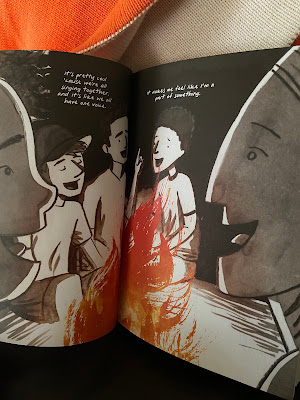

 
As a junior high teacher and librarian, I can attest that the moments of bullying and teasing are 100% authentic.  In Flamer, the reader experiences what Aiden does as he tries to navigate his place in an ever-increasing environment that tells him he needs to be an "alpha-male" while he doesn't have those inclinations. He also has racist remarks thrown at him for being Asian.  At one point, a well-intentioned friend, tries to tell Aiden to draw less attention to himself and Aiden questions how he can do that.  This is a very real dilemma that teens go through and Curato writes this delicate scene with such care, it's incredible. Readers can discuss what their experiences have been with racism towards Asian people and what they can do to stand up against that hate. 


Finally, the part that I really enjoyed was Aiden's relationship with his only friend who allows him to be his true self.  His pen pal, Violet, is a trusted ally whom Aiden confides his thoughts.  This is a beautiful model of how even having one person who is on one's side makes a big difference in a person's life. Allyship is a topic that young people can discuss throughout this story and into their own lives.  Aiden has some people who seem to be on his side but then change their mind once they realize that others call him out about being gay.  


Aiden's coming-of-age realization about his sexuality is something that others may be able to relate.  His religion has taught him that homosexuality was wrong so Aiden denied being gay when his classmates bullied him about it.  Only after his dreams started showing his true feelings was when he started to come around to possibly accepting this aspect about himself.  Some of his trusted scout leaders tried to help him through being himself but they ended up being outed and ultimately fired from the scout camp.  This is another reflection of the times and even some discrimination against the LGBTQ community in today's world.  Readers can discuss the factors that are at play and what they can do when they see this happening in their communities. 

Overall, Flamer is a book that embodies a number of adolescent emotions and should be available to young adult readers who want to read it.  It would also benefit educators, counselors, social workers, families and care givers to read it in order to broaden their understanding of a young person's needs during this critical time of their development.  It may very well save a life. 


Friday, February 18, 2022

From a Whisper to a Rallying Cry: Asian-American activism begins


From a Whisper to a Rallying Cry: The Killing of Vincent Chin and the Trial that Galvanized the Asian American Movement by Paula Yoo is an award-winning non-fiction, young adult book that looks deeply at the people and circumstances that launched activism for Asian-Americans.  Yoo uses primary sources and interviews from the 1980s to the present-day hate crimes against Asian-Americans due to the Coronavirus pandemic to put the whole plight of Asian-Americans in context.  This is a valuable book for U.S. History classes, social justice and law classes, as well as for teens and adults who want to learn more about other civil rights movements aside from the ones for Black people and perhaps the LGBTQIA+ communities. 

Detroit in 1982 was full of tension.  Tension between Asian-Americans and those in the automobile industry.  When a Chinese-American man, Vincent Chin, was brutally killed by two white men and the sentence was only probation and a $3000 fine, the Asian-American community organized to protest against this injustice.  Chin's wrongful death was the first case brought against someone's civil rights being violated.  The prosecutors retried the defendants claiming that their crime was racially motivated and that violated Chin's civil rights that were protected under the law.  What ensued was a years-long battle in and out of the courts with multiple law enforcement, attorneys, witnesses, and national figures for justice being pulled back in to find closure on the case.  

What stood out to me was how ordinary, everyday people got involved in the movement. For example, Mable Lim, an elderly woman who drove around Detroit with press releases shared that when she was younger she never stood up to the racism she encountered. "I accepted it, you're used to being excluded and treated differently."  Many readers may relate to Lim and her perspective, even to this day.  Marginalized groups benefit from learning about the past where coming together for a common cause brings strength to the community as a whole.

Another part of this story that was especially informative was how all-encompassing the movement became.  At first it was Chinese-American activists that then grew to Japanese-Americans, then the NAACP and Pacific Islander groups joined.  During a march an elderly Filipino man was asked why he joined and his reply encapsulated the feeling for justice, "If we don't stand together, we'll always be divided."  This book teaches the origins of the term Asian American and Pacific Islander.  Readers can better understand how these modern-day terms came about and how they are used today.

Finally, the true-crime aspect of the story is also a reason why I recommend it to young adults and adult readers.  Yoo writes in a narrative style similar to true crime podcast scripts that provide details to the reader about the background of each person involved in the case.  The courtroom scenes and judicial procedures are also notable because they were the cause of laws actually changing to ensure equitable sentencing procedures for future cases.  Readers are also not lectured at in this book. For example, Yoo doesn't state her opinions about the motivation behind the killing.  She lays out the evidence from both sides and that is what is also good to read.  How she handles the effects on the defendants' lives brought a more balanced approach to this story.

After reading this book readers will undoubtedly want to do their own research on the case and the people involved.  Yoo provides numerous sources for further reading, including the film, Who Killed Vincent Chin? Here is an interview from the Glendale Library that was done with Yoo:


Sunday, January 23, 2022

Revolution in Our Time: the Black Panthers' rise, fall & legacy today


Kekla Magoon's young adult, nonfiction book, Revolution in Our Time, about the history of the Black Panthers, their enduring struggle for progress in their lifetimes and the recurring themes in the modern-day American society is a poignant informational book that benefits everyone who reads it.  

The Black Panther Party played a large role in pushing back against racist policies in communities, however, the media portrayal focused on the sensational aspects rather than the multi-faceted parts of the movement that actually helped communities.  This is where Magoon's book comes in to set the record straight on how women and children were the focus in order to provide for their basic needs while in poverty.  

The book starts out when in 1967 a group of Black Panthers walked onto the floor of the California State Legislature to express their position on Black people being able to defend themselves against unlawful attacks.  How did this group form and come to this pivotable moment when they were splashed in headlines all around the country?  Magoon then takes the reader back to 1619 until 1965 and summarizes how Black people have endured inhumane treatment up until 1965.  She explains the group's formation in 1966 during the Civil Rights Movement and how they grew in numbers all while being targeted by law enforcement and the FBI.  Magoon finishes the book by going full circle to when the group disbanded in 1982 until the present day struggles for the same protection under the law that was the cornerstone of their platform from their formation. 

It reminded me a lot of Stamped: Racism, Antiracism and You and You Call This Democracy?, both written with a young adult audience in mind.  Our youth deserve to know the historical events that have led our country to the state it is in and how they can help improve their world by not repeating mistakes of the past and recognizing what has worked before.  This is an excellent book for teens and adults to read together and use it study the figures and events on their own.  Full of photographs, quotes, and a storytelling technique that will leave a lasting impression in the mind and heart of the reader, this should be shared and discussed by all who care about Black people.


Click HERE for my book review of this book.

HERE is a short video of Kekla Magoon discussing her book.

If you have middle grade readers (ages 8 - 14) who'd like to learn more about The Black Panthers I'd recommend Rita Garcia-Williams' award winning trilogy:


Thursday, October 14, 2021

Loretta Little Looks Back: Three Voices Go Tell It


Loretta Little Looks Back: Three Voices Go Tell It by Andrea Davis Pinkney and Brian Pinkney is like no other book I've ever read.  The multi-generational, historical fiction novel begins during an unfair sharecropping agreement between the main character's family and a plantation owner in Mississippi. Then it shifts to surviving under Jim Crow Laws to eventually marching for civil rights.  It's a dramatic series of monologues that follows Loretta Little (from 1927-1930), Roly (from 1942-1950), and finally, Aggie B. (from 1962-1968). Each chapter has a where and when to set the stage for the reader as they step into the heart and mind of the characters.  The first-person narration told in verse, song, and illustrations transport the reader to the emotion of each character.

What stood out was how the author, Pinkney, incorporated real-life historical figures into her storytelling.  Readers can learn more about Fannie Lou Hamer, President Lyndon B. Johnson, James Forman, Emmett Till, Charles McLaurin, and of course, Martin Luther King, Jr. Pinkney also includes more information about sharecroppers in the southern U.S. with additional photos from that time.  

As a parent, teacher and librarian, I would share this book with 3rd graders and above.  It's certainly age-appropriate for readers to learn about the southern Black experience in the U.S.  Each character is strong, distinct and unforgettable.  The illustrations help readers understand the essence of the story without giving away too much.  

Here are several video interviews the Pinkneys did to share with readers:


Saturday, August 28, 2021

Hearts Unbroken: a young adult #CreekVoices tale of love and hate


Hearts Unbroken is a young adult chapter book written by New York Times best-selling author and former KU Jayhawk, Cynthia Leitich Smith.  Universal themes of caring about others resonates through each page.  

Lou's entering her senior year at a Kansas City high school and she's just broken up with her popular, jock boyfriend who made fun of her Creek heritage.  Lou's dedicating her time to focusing on school and her family, especially since her younger brother, Hughie, is a freshman and he makes it into the musical production of the Wizard of Oz to the dismay of many in the community who want to see white students cast in the big roles.  The town becomes divided on if it makes a difference as to who plays the characters and if those casting decisions affect the purity of Baum's story.  Hughie even gets threats in the mail that scare Lou.  Although Lou was definitely not on the lookout for romance, she is swept up in the arrival of Joey, the new Lebanese-American student who is working with her on the school newspaper.  Will she be able to follow her heart and make better choices that will strengthen her identity?

What stood out to me about this story was the network of community support that Lou has throughout her ups and downs.  Lou asks her father, how do you tell someone you care about them with the fear of rejection at hand?  He says,

"What I wouldn't give for this to be the worst problem you'll ever have.  But, pumpkin, caring about somebody isn't trivial.  It can keep you going."  

Readers can discuss times that they've had people express their care towards them and who they care about the most in the world.  

Another part of the story that I appreciated was the role of the librarian in the story!  It showed how librarians are trained to connect the right person with the right book.  For example, the librarian buys a book for Hughie, If I Ever Get Out of Here by Eric Gansworth of the Onondaga Nation.  Readers can ask their librarians for topics that interest them and have a conversation about books and authors that they may try out.  


The overarching theme is how racism seeps into the daily lives of minorities.  Lou talks with her classmates whose parents are leading the charge against people of color holding main character roles in the musical and the classmates confess that they hear racist conversations in their households.  They thought that Lou would assume that they shared these racist ideas as their families did, but Lou tells her friend, "You're not your parents."  This is a powerful moment where readers can decide what to do and say when they realize that their families have racist or prejudiced opinions about others.

Readers can find real life examples of when traditional White roles have been cast to people of color.  In the story, the role of Dorothy goes to Chelsea, a Black student who is a talented performer.  This is similar to when the live action movie of The Little Mermaid cast Halle Bailey in the role of Ariel and there was pushback from some Disney "purists" who believed this was not a good choice. Readers can share their opinions about where they stand on this issue.


Smith also touches on the racist background of the Wizard of Oz writer, Frank Baum.  Hughie discovers this while researching his role and finds editorials from a South Dakota newspaper that Baum wrote advocating for the genocide of Native Americans.  What's impressive is that Smith doesn't just write about them in passing, but has the actual primary sources from the newspaper printed in the chapter.  Readers can discuss what options people have when learning about the true nature of creators from the past.  I don't want to spoil the story so I won't mention what Hughie does here, but readers can share if they agree with Hughie's decision or not.

Lou also faces conversations about race and prejudice with Joey since he is Lebanese.  Readers can think about the stereotypes associated with people from the Middle East and how they can go about talking about those with others.  I'm impressed by Smith as she weaves all of these important topics into an entertaining, heartwarming story about a Creek young woman coming into her own. Lou's not perfect and that is something to which everyone can relate!

Smith's website has a treasure trove of resources for book clubs and more. I hope young adults and adults read and discuss this award-winning book.


Sunday, June 13, 2021

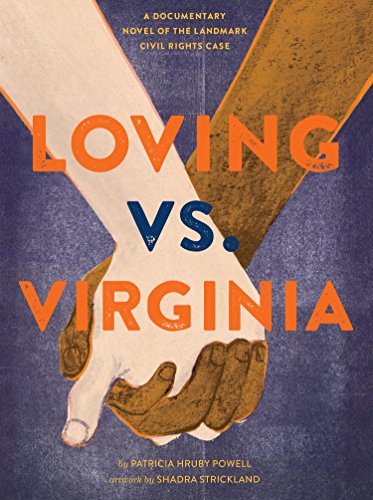
Making Interracial Marriage Legal: Loving Vs. Virginia


According to Britannica.com, Loving v. Virginia, legal case, decided on June 12, 1967, in which the U.S. Supreme Court unanimously (9–0) struck down state antimiscegenation statutes in Virginia as unconstitutional under the equal protection and due process clauses of the Fourteenth Amendment.


A middle grades, historical fiction, novel-in-verse, Loving Vs. Virginia by Patricia Hruby Powell and illustrated by Shadra Strickland,  tells the story of a civil rights topic that has everlasting effects on the U.S.  

In the 1950s a majority of the country had laws against people of different races marrying.  Through this story the reader learns of Mildred (Millie), a young Black woman who lives in Virginia with her large family out in the country.  They farm, run a business and love playing music and dancing with their friends.  Richard, a young white man, is one of those friends who grew up with Millie.  As they get older they fall in love and have two babies.  They go to Washington D.C. to get married but are arrested after they return to Virginia.


Told in alternating viewpoints, the story unfolds as Rich and Millie Loving become outspoken about their right to marry and live in Virginia with their family.  Their tale is interspersed with primary sources that take place alongside their landmark Supreme Court case.  Moving, tender, and honest, every teen should read this book to understand more about the history of race relations and civil rights in this country. 

Watch a video interview of the creators of this book HERE.

Friday, May 21, 2021

Take Back the Block: a middle grades activism tale


Take Back the Block by Chrystal D. Giles is a middle-grades, fictional chapter book that centers on the gentrification that is happening all over this country.  The main character is 11 year-old Wes who has grown up in his neighborhood of The Oaks for his entire life.  In fact, he lives in his grandfather's home where his mom grew up, too.  She drags him to social justice protests every weekend but he cannot see how it relates to him. He thinks, "I got why we were there, but I was a little tired of fighting battles that didn't have anything to do with me."

As he's making the transition from elementary to middle school, he is worried about looking cool, keeping up with his studies, but certainly not his friends.  He has a tight-knit crew of Alyssa, Brent, Jas, Mya, and Kari.  Even though My and Kari are on the outs, he has high hopes that they will get past it soon.

Unfortunately once the school year begins, a real-estate development company offers residents of The Oaks over appraisal value for their homes so that they can demolish and build new condos and retail plazas there.  At first, some of the residents want to take the money and leave, but over time they realize that their neighborhood has more value than money.  It is a community, a home nestled near the inner-city of a bustling place.  Why should they be forced to move away just so higher-wage earners can live in their part of the city?

Wes is determined to help his activist parents with this problem.  He invokes the help of his new teacher who connects him with a community organizer and from there, there is hope!  Wes and Alyssa research ideas on how to save their community and actually find one way that could possibly work. His teacher tells him, "this is why I wanted you to research social justice.  Being aware of what's happening in society connects us to the world around us."

I loved this story because it was fast-paced, full of dynamic characters and a truly realistic problem facing communities today.  There are lots of opportunities for readers to discuss what they think about Wes and his friends and family.  The story is about gentrification, but it is also about the bonds of friendship, poverty, racial profiling, family and standing up for what's right.

When I first heard about this story I thought that I wouldn't be able to relate to it because I live in a college-town.  After reading and enjoying it immensely, I highly recommend it to middle grade readers, educators, community members and families.  Giles writes with humor, heart, and a memorable tone. She even dedicates the book to her "son, Ezra, may you always take up space, be visible, and raise your voice." This is what I, too, hope for my students and daughter.

Here is a free excerpt from the book or listen to Giles read the first chapter here.

Sunday, May 9, 2021

Infinite Country: a multi-generational saga in less than 200 pages


Infinite Country, a young adult and adult novel, by Patricia Engel clocks in at less than 200 pages, but it is a richly told story of a Colombian family whose choices have everlasting effects on future generations.  Engel rotates the point-of-view throughout the story so it is told in a series of present-day snapshots and flashbacks to when their family was started with the union of Elena and Mauro.

The story opens with 15-year Talia's breaking out of a juvenile detention facility in the Andes mountains, "it was her idea to tie up the nun."  Immediately the reader is drawn into the story and curious about all of the events that led to that point.  Thankfully, Engel reveals just enough information through each character's chapters so it slowly trickles out, piece by piece.  Talia's crime was justified in her mind yet "Talia considered how people who do horrible things can be victims, and how victims can be people who do horrible things."  Readers can discuss if this is true and when history has done this for various people.  Does this still happen today?

As the story moves forward the reader learns that "Talia's mother was abroad and sent Talia to Columbia when she was a baby but this story was so common it couldn't possibly be considered trauma."  The choice that Elena makes resonates with everyone in the family.  Readers can discuss if this is truly traumatic and in what way?  Engel continues to divulge more of the how and why behind Elena's decision and the way it is revealed through the different characters' chapters makes it most heart-wrenching to read.  

"People say drugs and alcohol are the greatest and most persuasive narcotics--the elements most likely to ruin a life.  They're wrong. It's love."  Engel drops this incredibly deep thought in the middle of the story as Mauro is dipping in and out of sobriety in his attempt to deal with the splitting up of his family.  Readers can talk about addiction and the ways in which love drives people to do the unthinkable.  How does Elena and Mauro's love story ruin lives? Did it ruin their own, their children's, Elena's mother's, or all of theirs, or none of theirs?

Another aspect of this novel that is especially meaningful is the idea of dual-identity that immigrants continually must grapple with on a daily basis.  Elena thinks, "when you leave one country for another, nobody tells you years will bleed together like rain on newsprint.  One year becomes five and five years becomes ten. Ten years become fifteen."  Even over the course of many years in another country, immigrants hope to one day return, but in this story, Elena cannot just visit Columbia since her status is undocumented.  Her family in the U.S. must straddle the awkward rope of trying to fit-in while not standing out and attracting the attention of authorities.  Readers can discuss the stress of living this way.  What are the drawbacks of this life for Elena and her children?  What are the benefits? Which outweighs the other?


Elena and Mauro's children's perspective are told in vastly different ways. Talia, the youngest, is in Colombia with her father and her side of the story is the first the reader learns.  Karina, the first-born, is in the U.S. with her mother and younger brother, who was born in the U.S. so his experience contrasts to hers.  She has to go to great lengths to wrap her mind around half of her family being in another country. A country that she is a citizen of but will never live in, unless she is found and deported by ICE.  Nando, the only son of the family is bullied incessantly but he keeps it all to himself.  Nando and Karina's perspectives are ones that readers can discuss. Who has it better?  

Elena "blamed herself for displacing her own children, especially her girls.  Karina and Talia, binational, each born in one country and raised in another like repotted flowers, creatures forced to live in the wrong habitat."  Mauro's upbringing, what he teaches Talia in terms of folklore and native Columbian stories, weaves its way through the story.  Engel beautifully uses the stories of the serpent, princesses, jaguar and condors to reflect what is happening to the family.  Readers can try to find the parallels in these mentions. Which family member fits each animal's role?

Overall, this story leaves the reader with hope, want for action on current immigration policies in the U.S., and more empathy towards immigrant stories.  Engel's Columbian background adds authenticity to every layer and is a must-read for any young adult and adult. 


Saturday, May 1, 2021

We are home: A Pho Love Story


 A Pho Love Story is a young adult, romance debut novel by Loan Le, about rival Vietnamese restaurants in L.A. whose owners have a long history of animosity and competition. Imagine the mess that ensues when their high school seniors, Bao and Linh, become partners for a school project and end up falling for each other!  This is an important story about how family and cultural pressure can influence the children of immigrants.  Rather than communicate their needs and wants, immigrant children often go-with-the-flow and end up stressed.  A Pho Love Story is a richly layered story full of humor, bonds, love and hope.  It resonates strongly with people who straddle dual cultures and don't want to let anyone down, including themselves.

As a teacher, librarian, and parent, I would use this book to discuss many topics with readers. Starting with the main characters, Bao and Linh, whose point of view changes with every-other-chapter.  Bao accuses Linh of being a liar because she isn't forthcoming with her family about her true passion of painting.  Readers can take a side and debate who is in the right and wrong in this situation.  

Another topic for discussion is how Bao and Linh go about their romance.  At first they hesitate to partner up because for their entire lives they were told by their families that it was taboo to associate with the other.  Despite their apprehension over being seen by someone in their community circle they embark on a friendship which grows into a romance.  Do readers agree with how the events unfolded?  Were there any times when they could've come clean with their families?

I just loved the friendship between Bao and Linh.  The more time they spent together the more they discover all that they had in common: they both recognize their Vietnamese culture along with the pressure to make their families proud.  It is unique to live in America where, as the children of immigrants, they are exposed to more avenues and opportunities than their parents.  Communicating this with their parents is difficult because their parents are unknowledgeable about how these experiences lead to future success.  Readers can talk about anyone in their life whom they feel like can understand them and their background.  

As the child of immigrants myself, I connected to this story especially when Linh was looking at old photographs of her parents from Vietnam.  She notices how happy and idyllic the scenes are and thinks, "It seems impossible to think that outside the frame of this photo, the country they knew was changing rapidly.  And yet here they were: joyful."  It would be interesting to pose this question of what is happening outside of the frame when looking at photos as primary sources with students.  Although countries go through so much change that their citizens are pushed or pulled to emigrate, the constant that they feel is family, cherished moments and unforgettable memories.  This is universal.  Which is what hurts when in the story there is a racist posting online with the person telling those in Little Saigon, "go home!"  Bao responds by writing an op-ed titled, "We Are Home".  His message is that immigrants are real people with a past that needs to be listened to in order to understand why they would leave their homes in order to make a better life here.  In the wake of the anti-Asian hate-crimes on the rise recently, his writing hits hard.

Le also captures what it is like when your secrets are revealed to your parents.  When the truth is out and you have to deal with the shame that stems from disappointing them, but also the other side of the feeling that what you did and hid from them was something that felt perfectly natural to you.  Linh calls the aftermath of her parents finding out as, "Terse. Cold. Punishing."  Readers can talk about times when they kept secrets from their loved ones or friends.  What was keeping them from being honest? Did they find ways to get through it? 

The most uplifting part of this whole story is the network of support that Bao and Linh have through their friends, teachers, neighbors, and family members who see their struggles and encourage them.  Like when Linh's aunt says to her, "Be the brave, honest person I know you are."  Readers can name people in their lives who provide this advice and kindness to them.  Maybe they are that support system to others in their lives.  Why is it important to form and nurture these relationships?

All in all, I absolutely loved this book. I'd recommend it, even to adults, because it has universal themes and good knowledge to bestow about Vietnamese history, food, language, and culture as a whole.  For example, how to pronounce PHO: it rhymes with, "huh?" Thank you, Loan!  I had never read a book with Vietnamese characters that I can recall and I cannot wait to read more from this amazing author.

Thursday, March 11, 2021

Prairie Lotus: a Chinese-American perspective


 Prairie Lotus by Linda Sue Park is a historical fiction novel perfect for 3rd graders and up.  

This story is told through the 14 year-old character, Hannah.  She has been traveling on a wagon with her father for the last three years, after her mother's death.  They are on the emerging trails from California, moving eastward towards the Dakota Territory.  The white townsfolk are prejudice towards Hannah because she is half-Chinese and half-white.  Although she has never been to school, Hannah excels in her studies and makes a few friends.  Despite her success in school, she is unsure of her future in such a racist community.  Thankfully, her talents for sewing and dress-making offer a hopeful venture that will allow her to be an independent and respected person in the community.  Will the townspeople get over their suspicions and accept Hannah and her father?  

Park explores many topics that are important for the discussion of U.S. History:  immigration, the treatment of Indigenous people, racism, settling into towns, early education, gender roles, and a different view of "Westward Expansion" than is presented in textbooks and other children's stories.  As a teacher and librarian, this book is ideal for exploring how Indigenous people were treated, along with immigrants.  Women's gender roles are also a good topic that are shown in this story.  In what ways does Hannah fulfill her duties and how does she challenge what society dictates as her place in the world?

Here is an audiobook sample to listen to and share with readers.

Sunday, February 14, 2021

The Awakening of Malcom X: a novel


The Awakening of Malcom X by Ilyasah Shabazz with Tiffany D. Jackson is a moving narrative biography that focuses on the years that X spent in prison from ages 20 to 27,  where he learned about the teachings of Islam and was shaped into the person he became to lead the Nation of Islam. 

"Wake up, Malcom!"

 Told in three parts from the first time he steps into the horrendous prison in Charlestown where he loses the willingness to improve his mind, to part two where he is enlightened by self-education in the library and his family's support, and concludes with part three where he gets transferred to a better facility in Norfolk where he joins the debate team.  Throughout his time in prison he has flashbacks to his family and reflected on ways he can help his people be free.

"Up, up you mighty race!"

I was already familiar with Malcom X's teachings and speeches, however, the way that he came to the religion was new information.  Since Shabazz is his daughter she had first-hand knowledge of the letters he wrote back and forth with his family and with Elijah Muhammad.  The part that stood out to me was when he discovers that, "even a crumb of dignity can change the way you look at the world and the way you see yourself in it."  Once he was given the chance to prove his worth to his fellow inmates and to the outside world, he only wanted to inspire others to follow suit.  

"Everybody needs their family, Malcom. We're always with you. Don't ever forget that."

This story sparks a lot of questions for students and even adults.  They can delve deeper into Malcom X's speeches and what happened to his position in the Nation of Islam.  Inquiry into the role of prisons and incarcerated people can also stem from this story.  Finally, the role he had in the Civil Rights Movement can also be explored further. 


Almost American Girl: an illustrated memoir


Almost American Girl by Robin Ha is a poignant story on immigration and cultural norms that emotes empathy for anyone who has been made to feel like "the other."

 For 14 years Chun is raised by her mother in Seoul, South Korea. Chun and her mother face prejudice there because of her mother's unwed status.  During the summer Chun's mother announces a surprise trip to Alabama to visit a new friend.  Unbeknownst to Chun, her mother had no intentions to return to Seoul. Chun was blindsided. She didn't like Alabama because she hardly spoke English, had racist classmates, and she wasn't able to say goodbye to her friends back at home. Months of isolation and loneliness caused Chun to doubt her mother's life choices.  With flashbacks that filled in the backstory of Chun and her mother's life, the story moves in a hopeful direction when Chun finds friends in a comic book club.  

This story connects to me as in immigrant because like Chun, I was asked if I wanted to choose an American name to go by in school.  Before my kindergarten enrollment I spent weeks deciding what name would be a part of my identity.  For Chun, it was Robin.  For me, it was Fallon.  Asking a 5 year old or a 14 year old that question is a heavy load for them to process. The choice empowered Chun because it allowed her to start fresh in a new school.

Robin's story also connects to me as a teacher, because I, too, have had students who have immigrated to the United States.  I knew how important it was to build relationships with them and their families.   In the story, Robin has a strong relationship with her English/Language Arts teacher.  They write back and forth in Robin's journal and she encourages Robin to speak up for herself.

Robin was rescued from feeling isolated by reconnecting with her friends in Seoul.  "Even though my friends weren't with me, knowing that they cared gave me strength."  This is the part that truly saves Robin.  She had to feel like herself again before she could be vulnerable to explore her interests in Alabama.  Knowing that her friends back home were rooting for her gave her the confidence to try harder.


Dasia (Forever)-a middle grade novel tackling serious topics

  Dasia (Forever) by Nic Stone , a middle grade novel sprinkled with letters in a verse format, provides a raw, emotional perspective of Da...