Stories are magical, for both the young and old. Here you can find book reviews for specific age groups, topics, or learning experiences. There are also booklists and lesson ideas for educators, librarians, and families.
Flamer, a semi-autobiographical graphic novel by Mike Curato, is an emotional story of Aiden, a Filipino American boy who is spending his last week of summer break at his favorite place, his scout camp. The year is 1995 so the times reflect an era of homophobia, bullying, and lack of resources that could help a teenager who is questioning his identity.
I was surprised to learn that Flamer has been challenged and even banned in school libraries across the country, despite winning a book award. The audience for the book are young adults who are the same age as the main character. Readers will be able to empathize with Aiden's apprehension for starting high school, his insecurities about his body image, and his surprising attraction to his friend. Although the book climaxes with a suicide scene, Aiden does not go through with it and it ends on a hopeful note. The author's note states that these were actual instances that he experienced so I believe it will help others, either as a friend or family member of a person exhibiting Aiden's characteristics or for people thinking similar thoughts as Aiden.
What I liked about this book was the honesty with which Aiden's voice permeates the entire story. I have yet to read a book that explores a boy's insecurities about his body with as much care as Curato write's Aiden's feelings. Many readers will be able to relate to Aiden and his reluctance to draw attention to his body as he constantly compares it to others in his camp.
Another aspect of the book that stood out to me was the setting. Aiden finds so much peace in being outside in nature that it becomes his happy place. I think that other readers may also find solace in going outdoors when they are feeling stressed or need room to think. It also may encourage others to seek out ways to spend time outdoors with friends to increase endorphins and relieve them of social anxiety. The camp also lends itself to a sense of community that readers may look to join in order to feel as a part of a group.
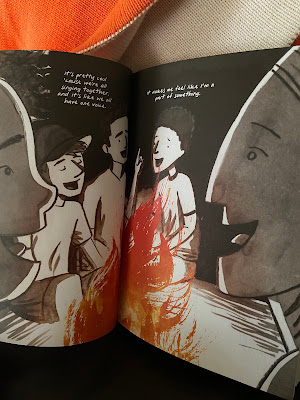
As a junior high teacher and librarian, I can attest that the moments of bullying and teasing are 100% authentic. In Flamer, the reader experiences what Aiden does as he tries to navigate his place in an ever-increasing environment that tells him he needs to be an "alpha-male" while he doesn't have those inclinations. He also has racist remarks thrown at him for being Asian. At one point, a well-intentioned friend, tries to tell Aiden to draw less attention to himself and Aiden questions how he can do that. This is a very real dilemma that teens go through and Curato writes this delicate scene with such care, it's incredible. Readers can discuss what their experiences have been with racism towards Asian people and what they can do to stand up against that hate.
Finally, the part that I really enjoyed was Aiden's relationship with his only friend who allows him to be his true self. His pen pal, Violet, is a trusted ally whom Aiden confides his thoughts. This is a beautiful model of how even having one person who is on one's side makes a big difference in a person's life. Allyship is a topic that young people can discuss throughout this story and into their own lives. Aiden has some people who seem to be on his side but then change their mind once they realize that others call him out about being gay.
Aiden's coming-of-age realization about his sexuality is something that others may be able to relate. His religion has taught him that homosexuality was wrong so Aiden denied being gay when his classmates bullied him about it. Only after his dreams started showing his true feelings was when he started to come around to possibly accepting this aspect about himself. Some of his trusted scout leaders tried to help him through being himself but they ended up being outed and ultimately fired from the scout camp. This is another reflection of the times and even some discrimination against the LGBTQ community in today's world. Readers can discuss the factors that are at play and what they can do when they see this happening in their communities.
Overall, Flamer is a book that embodies a number of adolescent emotions and should be available to young adult readers who want to read it. It would also benefit educators, counselors, social workers, families and care givers to read it in order to broaden their understanding of a young person's needs during this critical time of their development. It may very well save a life.
April is National Poetry Month but we really celebrate the art of language all year long. Stories that are told through verse are interesting ways to read, reflect, and listen to narratives. Our students find that reading a novel-in-verse is another experience in reading in that it often goes by quickly and they are tempted to go back and re-read lines and phrases that stick out to them.
All of these books listed below would be ideal for book clubs or just for reading and reflecting on one's own. From historical fiction, to biographies, realistic fiction, memoirs, immigration, religion, refugees, family, friendships, sports, school, bullying, identity and travel, these stories below have something for everyone.
The Cat I Never Named: A True Story of Love, War and Survival by Amra Sabic-El-Rayess with Laura L. Sullivan is a young-adult memoir that resonates with anyone who has had connections to persecution, uncertainty, and wanting to live life with dignity and hope. This is the story of Amra, a survivor of the Bosnian Genocide from 1992-1996. She is 16 when she learns that because she is Muslim and lives in Bosnia, her life is threatened. Although she lives among Serbs and Jewish people, there are tensions of war coming closer to her town, Bihać.
The only light in her life is when she befriends a stray cat. The cat, Maci, ends up performing miracles and saves the life of multiple people throughout the war. While Amra and her family find ways to evade starvation and build community despite the whole world seeming to ignore their strife, Maci continues to be the constant comfort in their lives. Amra's parents hide Muslim soldiers who run away from serving in the Serbian army. One solider tells Amra, "Thank you, you and your parents for being lights in the nightmare of my life." When refugees pour into their city, Amra and her family find ways to help them. "Without question, without reward, we help." Her father, Tata, says, "A drop in the ocean. But many drops can turn a tide."
The constant hope that Amra has is to survive the war and continue her education. She says, "One of the greatest responsibilities is knowledge." How can she hold on to this hope when there is such devastation around her? She finds that, "The world is a beautiful place. It's not beautiful everywhere, but that just makes it more important to look for the beauty." Amra's strength comes from her family's belief in her abilities. She is determined to be successful at any cost. "I won't let the world go black around me. I'll kindle a new light. With study and knowledge and persistence...and hope."
Told with a rawness that will make you want to learn more about this horrific war, Sabic-El-Rayess and Sullivan detail the events and connect them with strong characters. This story will remind people of where they were when they learned about the genocide in Bosnia and what was being reported in various parts of the world. It is especially interesting because Sabic-El-Rayess and Sullivan do not stop the story once the war is declared "over". Too often people who are apart from a war think it is like closing a book. This story is unique in its exploration of what happens to cities and its people after a war. "Left for any traumatized survivors is yet another trauma." This is in terms of rebuilding one's life and country.
For further reading at the end of the book is a comprehensive list of books and sites for further research. There are even film suggestions about the war in Bosnia. The author's note describes how her story parallels life under the current COVID-19 pandemic with being isolated and wanting any sense of normalcy, school, anything! She continues to share the state of Bosnians and Serbs today. Her hometown of Bihać is currently taking in refugees from around Europe. She also gave an excellent interview about her book.
Almost American Girl by Robin Ha is a poignant story on immigration and cultural norms that emotes empathy for anyone who has been made to feel like "the other."
For 14 years Chun is raised by her mother in Seoul, South Korea. Chun and her mother face prejudice there because of her mother's unwed status. During the summer Chun's mother announces a surprise trip to Alabama to visit a new friend. Unbeknownst to Chun, her mother had no intentions to return to Seoul. Chun was blindsided. She didn't like Alabama because she hardly spoke English, had racist classmates, and she wasn't able to say goodbye to her friends back at home. Months of isolation and loneliness caused Chun to doubt her mother's life choices. With flashbacks that filled in the backstory of Chun and her mother's life, the story moves in a hopeful direction when Chun finds friends in a comic book club.
This story connects to me as in immigrant because like Chun, I was asked if I wanted to choose an American name to go by in school. Before my kindergarten enrollment I spent weeks deciding what name would be a part of my identity. For Chun, it was Robin. For me, it was Fallon. Asking a 5 year old or a 14 year old that question is a heavy load for them to process. The choice empowered Chun because it allowed her to start fresh in a new school.
Robin's story also connects to me as a teacher, because I, too, have had students who have immigrated to the United States. I knew how important it was to build relationships with them and their families. In the story, Robin has a strong relationship with her English/Language Arts teacher. They write back and forth in Robin's journal and she encourages Robin to speak up for herself.
Robin was rescued from feeling isolated by reconnecting with her friends in Seoul. "Even though my friends weren't with me, knowing that they cared gave me strength." This is the part that truly saves Robin. She had to feel like herself again before she could be vulnerable to explore her interests in Alabama. Knowing that her friends back home were rooting for her gave her the confidence to try harder.
Apple: Skin to the Core by Eric Gansworth is a touching and haunting memoir. Told in verse, it is full of stories and photography that opens with Gansworth's grapndparents' school photos from Carlisle, the Indian Internment School. It ends with a photo of Gansworth in his Batman cape as a child on the Rez. So it truly comes full circle.
What makes this memoir stand out is Gansworth's artwork throughout the book. It enhances the stories and memories he chooses to share.
He writes of the rules, opportunities, lost language, and learning how to be himself when he ultimately chooses to leave the Rez to enter the White World. This is a book for young adult and adult readers to understand one person's family history and the affects that the U.S. Government had on them.
Everything Sad is Untrue by Daniel Nayeri is a gripping memoir of his childhood in Oklahoma. He is only a young child when he leaves his country, Iran, to embark on a journey of survival to finally land in Oklahoma. He recalls his earliest memories of his life in Iran before moving across the world. With equal parts humor, nostalgia, stark realism mixed with Persian history and poetry, Nayeri weaves a highly emotional story. It's definitely for an adult audience with complex themes of abuse, drugs, and religion.
As an immigrant myself, I am drawn to other immigrants' stories of the push and pull factors that led to relocating in the U.S. Learning about other people's stories allows me to reconnect to my own.