Search This Blog

Showing posts with label teamwork. Show all posts

Tuesday, May 30, 2023

Creative ways to end the school year


The end of the school year marks a unique opportunity for educators to create lasting memories with students. If you aren't able to try any of these activities out this year, keep them in mind as beginning of the school year rolls around or use them at the close of next year.

STEAM challenges

  • Students choose a book, either a new one or a past read that they enjoyed.
          They must create an object that goes with the book. Then they share the story and what they chose to create with their classmates. These can go on display or be taken home, depending on the materials used with the books. 

Pictured here are my students using LEGO blocks:


Students were challenged to build a troll bridge out of LEGO blocks. I gave them a piece of blue paper as the water and the only stipulation I made was that it had to be elevated, not touching the water.  As the students worked they found that they wanted to continue the challenge with more requirements, like the ones that are the sturdiest, tallest, etc. 

The best part was listening to them share their strategies for building and helping each other when they got stuck. It also inspired some to want to perform a reader's theater of the story! 


  • Put up a big Spot the Difference to complete as a class. Then challenge students to make their own and trade with one another. They can use old magazines to cut out pictures and words or use Google Slides or another digital format to make their pictures. 
The one shown in this video is from the publisher's website for the book, Someone Builds the Dream by Lisa Wheeler and Loren Long. 


  • Challenge students to create a BookFace photo. They will need access to a camera and book covers You can do this with book covers that are already separated from books or from the books themselves. In small groups, 3 people is usually good, students select a book cover that they can finish with their own bodies, faces, or other objects. Then students pose in a way that aligns with the book's cover art and another student takes the picture. Pictures can be edited and cropped so that only the BookFace remains.  Here are some of our favorites from this past year:


Blast From the Past

This is a fun way to look back on the school year and reflect on those moments of growth, humor, and classmates who have come and gone.  

  • Show photos and ask students to recall those lessons. I also record or have them write down what they are interested in at the start of the school year.  At the end, I share with them what they said and ask if anything has changed since then.  It is so neat to hear how their interests and lives change.

  • Roll videos produced by students, for example, stop motion films, book trailers, etc.  After looking at some, students asked to make more next year and for specific events, like, Talk Like a Pirate Day.  We even made several of our own as a class on our last library day!


  • Have students rank their top reads of the year. Our library management system allows them to see their circulation history, so students were able to rank their favorite books they checked out. 


Looking ahead
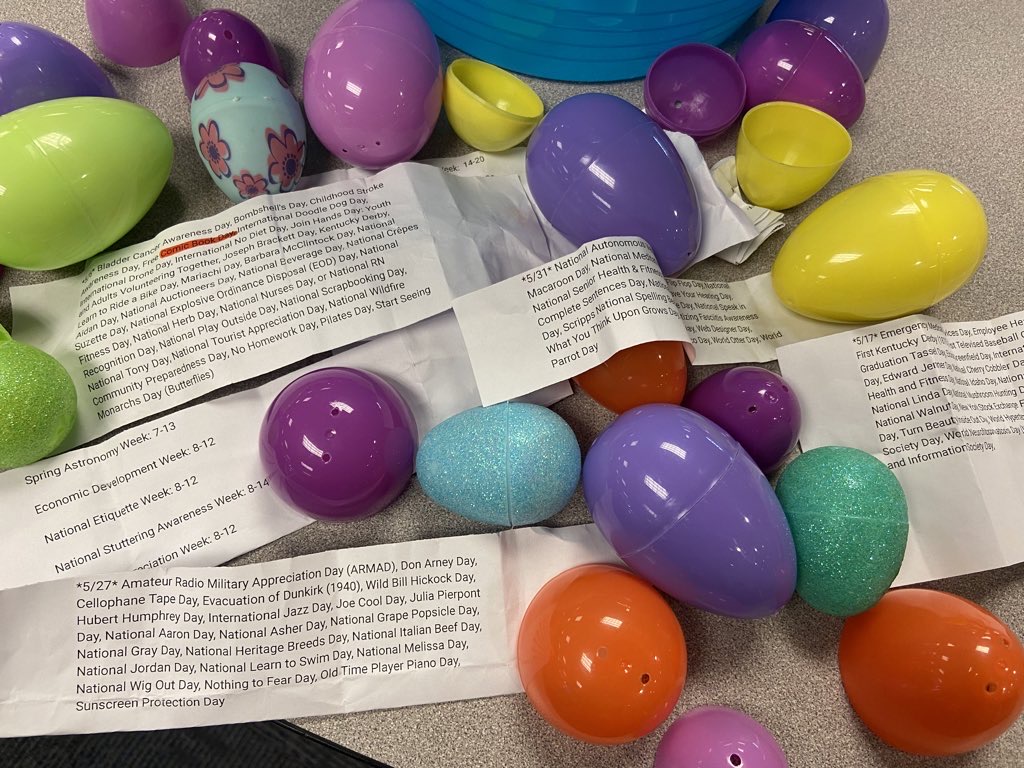
  • Share with students special days, holidays, or hide them in plastic eggs around the room. (I got the list from LM_NET and had to cut some out due to the age of my students.) Students select one to learn more about and then share with their classmates what they learned. You can have them write it on a sticky note, make a poster, or a digital copy.
This poster displayed here is from my Capstone Publisher representative:


  • Survey students about their opinions about the library program or your classroom.  I've had students use devices to fill out Google Forms and I've had them write their ideas on paper posted around the room.  This helps to shape the next year and gives students a voice:


Play unplugged games

  • Peep Knock-out: you take turns with a partner trying to knock a Peep off of the side of a table using only a plastic egg that you roll.  I heard about this game from a librarian colleague of mine and was waiting to play it on a special occasion. My 1st graders played the game and then we came together to critique it and adjust the rules for playing it again in the future. 


  • "Water Balloon Battle" or "________ Battle": You take turns launching a balloon on paper towards your opponents figures, also drawn on paper.  Your eyes are closed when launching and if you hit the figure then you succeed.  I first saw this on a fellow librarian's Twitter account and had my students play it, they loved it!  They also had fantastic ideas for adjustments.  
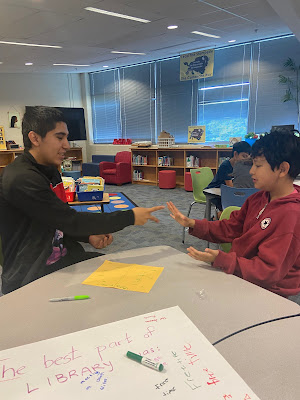
    • Follow the directions below for the rules to the tabletop game: 
Of course there are so many fun ways to end the school year or engage with learners to build community, please leave your favorite activities in the comments or if you have specific questions, send them my way.


Thursday, June 10, 2021

The House That Lou Built: what makes a home?


The House That Lou Built by Mae Respicio is an award-winning, middle-grades chapter book that is great for a book club, read aloud, or independent reading book.  It offers a unique look at the Filipino-American culture while exploring universal themes of grief, family, and friendship for a middle-schooler.


13 year-old Lou is half-Filipina, half-White but she identifies with her Filipina side since she lives with her mother's family in San Francisco.  Her father passed away before she was born and he left her some land as her inheritance.  When Lou visits her plot of land she feels at peace and connected to her father.  When her mother considers moving them away so she can find a better job Lou decides to build a tiny house on her land that she has always dreamed of building. Lolo, her grandpa, tells her, "That's how dreams work.  You just have to do them."  Perhaps this will convince her mother to keep them there?

Lou's community is an important part of the story.  Her mentors, Lolo, Annie, the salvage yard owner and shop teacher, Mr. Keller,  help her with her plans, as have her close friends and family members.  She even makes friends with the ever-popular, Jack, who she encourages to document her project.  Lou is not a typical character because she excels in building and engineering, which makes her stand out amongst her friends and classmates.  Her favorite place to be is the salvage yard because it inspires her to use the parts to invent new machines.  Readers can share a place that inspires them!  She also keeps a running 1,001 Cool Things to Build list and adds items to it, like a catapult.  Readers can add items to the list of something they'd like to build one day.

Lou's identity is an interesting theme that Respicio addresses in the story.  Lou says, "Being half and half is something I don't think about much."  Readers who are split between cultures can compare how they feel to Lou.  When Lou compares her grandparents from both sides of her family she says, "I never knew the difference between my white grandpa and my brown one because they loved me the same." Readers can discuss differences between their family members.  Lou describes her White and Filipina features noting that she doesn't look like her mom but "Mom knows that inside, I'm just as Filipina as she is.  We connect with each other no matter how different we look."  Readers can consider to whom they feel most connected in their lives.  Lou also compares her experiences when eating meals at non-Filipino households.  Readers can share about times when they were exposed to cultures outside of their own.

I enjoyed this story in many ways.   I learned about the Barrio Fiesta and how homes in the Philippines could be moved if flooding were to occur.  Readers can learn about the trials that immigrants endure when moving to the U.S.  I loved Respicio's description of the foods, dancing, and community in the story.  It reminded me of my own Persian community of ex-Pats growing up in Kansas.  

Readers will want to stick with Lou all the way to the end to find out if she ends up building her tiny dream home or if she has to follow her dad's advice she read in his journal, that "sometimes plans change."
Readers can also explore the Tiny House Movement and design their own as an extension idea.  

She has a strong outlook and jumps over the hurdles the adults put in her way.  My favorite line is when she says, "Sure, I'm only 13 but my ideas matter."  When I taught middle school students, this was the feeling that students said frustrated them the most, that they weren't being heard.  Readers can share what is important to them, just like Lou.


Monday, May 10, 2021

Fun games to play with K-12 students: in-person or virtually


 Categories: roll the dice or draw a card with a color and the student picks a square from that row and teams can come up with examples, pairs of students, or individuals or even the whole class can write or draw them.


The Name 5 came in my Pinterest feed and I saved it to use with remote learners, but my in-person learners loved to play it, too! Here is the original source for this sheet.


Another alternative way to play is to pick a category that goes with a book you will be reading & use the Name 5 as a concept formation tool.


Rock, Paper, Scissors tournament: did you know that the game has been around longer than the pyramids?  That's a fun-fact shared by author Drew Daywalt in his read-aloud video of The Legend of Rock, Paper, Scissors. 


 It is easy to do a class tournament which is in-person.  Pair students up, they play best out of 3 rounds and the winner gets paired up with another until there is one champion.  There are variations on this, like, the loser of the rounds sits down or they follow their opponent who beat them and cheer them on. This is the slide I used with my second graders and a video of our first round of playing. The second round went much better!


In a virtual environment there are also variations.  You can send partners into breakout rooms and then narrow it down from there.  Or you can pair opponents up and all stay in the same room.  For example, when I did this with 2nd graders I called the pairs out and made sure that they knew whose square to be focused on during the match.  The winner of the round keeps their camera on.  At the end of the round I re-paired them up for the next round, etc.  For the last round we all turned our cameras on and cheered them on.  


As a challenge you can ask students to come up with other ideas rather than rock, paper, scissors.  You can even show them the clip from The Big Bang Theory where Sheldon shares his version:


High Five tournament: Adam Rubin and Daniel Salmieri's picture book, High Five is especially fun to read before this activity.  


The book trailer previews some variations on the style of high fiving:


After watching you can ask students which ones they liked the most, which ones were the hardest, etc.  You can even have them recreate them and then choose one action to add on top of it.  Students can work on these alone or individually and share them on a Flipgrid and have students vote for their favorites. You can also have a tournament in your class with students competing and some acting as judges, like in the book.

Here are our kindergarteners following the directions for a partner high five challenge:


This was the list that we practiced a few moves at a time.  With older groups you can go through the motions and see who can perform them without looking at the list of directions:


Mannequin Challenge: Back in 2016 there was a viral video challenge that asked people to hold a pose while the camera spans the room.  You can do this with students by choosing a prompt, asking them to hold a pose that they interpret as a good response and either video tape them OR take photos.  Here is a clip of first graders holding a power pose:


We did this for Children's Book Week 2021 because the slogan was Reading is a Superpower. We replicated the girl in the center of the poster designed by illustrator Bryan Collier: 


Students shared their superpower poses and we copied classmates. I turned their photos into a collage to share with families.


Beautiful Oops game:


Read aloud (or show a video read aloud of the book) Beautiful Oops! by Barney Saltzberg & challenge your students to take one of the mistakes in the and show an example of it:

  • A spill
  • Bent paper
  • A drip of paint
  • A scrap of paper
  • A smudge & smear
  • A stain
  • Holes
  • A wad 
After they have made an example of a mistake they can put them all out on a table.  Pull students' names, one-by-one, and have them choose one of the mistakes to turn into something else, like in the book.

This is fun because it builds community, students love thinking about their connections to one another and this is one way to create that bond.  It's also enjoyable because they are all based on mistakes.  They won't be perfect and that is the whole point.  Students can be creative and if they are stuck they can use the book as a mentor text.

Finally, you can display the art and do a gallery walk with others in the school & see if they can spot the "mistake" that inspired the art!

You can even award a "Best in Show" and give them the follow-up book to Beautiful Oops!: My Book of Beautiful Oops! an interactive journal for young artists!

The book's website has more ideas on how to use the book and join the world-wide community sharing their Beautiful Oops on social media: 


Monday, January 18, 2021

What We'll Build: Plans for Our Together Future


What We'll Build: Plans for Our Together Future by Oliver Jeffers is a beautiful picture book that asks the reader to look to the future with hope.  My students shared what they planned on getting better at in the New Year or what they want to do less of.  This primed them for the book's message:  looking forward to taking action in your community with friends and foes.


The story opens with two pairs of hands that agree to start building. 
 I asked my students, who is someone with whom you like to build?  


It continues by showing the team building and taking things apart. 
I asked my students, what is something you've built and taken apart?


After much building the team takes a break in the story. 
I asked my students, where is your favorite place to relax and recharge your energy?


At one point in the story, the team hide behind a castle wall to steer clear from villains on the other side.  In the following page the villains show remorse and offer apologies.  On this page the team and the villains sit together at a table.  
I asked my students why this is an important message, to forgive one another.


My favorite part of this books is when Jeffers shows the ideas of the two team members colliding.  I asked my students what they want to build in their future.  With each turn of the page there are a number of conversations that come up.  

This is a graphically pleasing story appropriate for ages 4 and up.  
Jeffers' website offers FREE resources (craft and activity sheets) for many of his books, including What We'll Build.


Sunday, January 17, 2021

All Thirteen: The Incredible Cave Rescue of the Thai Boys' Soccer Team: how did they do that?


All Thirteen: The Incredible Cave Rescue of the Thai Boys' Soccer Team by Christina Soontornvat is a riveting, non-fiction account of the teamwork and scientific knowledge that went into saving the thirteen lives that were trapped underground.

We all heard the news coming out of Thailand in June 2018 when the boys' soccer team was trapped in the flooded caves with no way out.  We also know that every single member of that team made it out alive.  This leads to the inevitable question: HOW?  

Soontornvat happened to be visiting her family in Thailand while this event was unfolding.  She returned to the area to interview the people who were there and tour the land where this took place.  The mountain itself played an important role in the story.  Soontornvat examines the science of the caves, how they form and how rainfall during an unexpected time trapped the soccer team beneath the earth.

Other factors played a role in the rescue efforts.  Buddhism and meditation helped the boys and their coach survive the isolation. The political situation in Thailand and Myanmar and the "stateless people" was also explained since the coach and two team members were considered without a country.  This drew a spotlight to this issue in the region and they were granted Thai citizenship afterwards.  

Soontornvat describes all of the experts involved in the rescue.  From the Cave Man to military strategists, engineers, and cave diving experts who all flew in to help in getting everyone out.  She also highlights the numerous volunteers that gave their time to ensure everyone getting what they need to rescue the team.

The most suspenseful part of the story is when the Governor was finally convinced to allow a dangerous plan to get the team out and move forward.  I knew that the team was unconscious when they were taken out of the caves, but logistically, I had no clue what that entailed.  My daughter was surprised to learn that the boys' classmates volunteered to test out the diving gear before it was used in the rescue.

The saddest part was to find out that one of the volunteer cave divers lost his life during the rescue efforts.  The book is dedicated to him.  When the boys' team was recovering from their time in the cave, they learned of his passing and it affected them greatly.  

Of course the details of being trapped underground for so long were also revealed.  How did they survive without food, bathrooms, sunlight, a place to rest?

Overall this is a story of community, determination, and heroic cooperation.  For readers this book leads to numerous topics for further study and discussion: science, diving, nutrition, brain function, politics, etc. Soontornvat's website provides additional resources for readers and a discussion guide for adults.


Dasia (Forever)-a middle grade novel tackling serious topics

  Dasia (Forever) by Nic Stone , a middle grade novel sprinkled with letters in a verse format, provides a raw, emotional perspective of Da...